
Species Guide
The Complete Guide to Wild Sockeye Salmon
The deepest-colored, most flavor-forward wild salmon. Our family's catch since 1987.
Key Takeaways
- Vibrant red flesh, firm texture: Sockeye has the deepest natural red color of any salmon species, from astaxanthin it gets from krill and other prey; farmed salmon get astaxanthin added to their feed.
- Nutrient powerhouse: A 4 oz cooked serving delivers about 176 calories, 30 g protein, and about 970 mg of EPA + DHA omega-3s, plus 212% of the Daily Value for vitamin B12 (USDA).
- World’s largest sockeye fishery: Bristol Bay, Alaska produces 40–60+ million sockeye annually — the largest sustainable wild salmon run on Earth.
- Lean but flavorful: Leaner than king or farmed Atlantic salmon, yet delivers the most intense, salmon-forward flavor — a favorite among chefs.
- Versatile in the kitchen: Firm flesh holds up beautifully to grilling, pan-searing, baking, and smoking without falling apart.
- Truly wild, truly clean: Virtually all sockeye salmon is wild-caught. Zero antibiotics, zero hormones, zero artificial colorants — ever.
What’s Inside This Guide
Species Overview & Identification
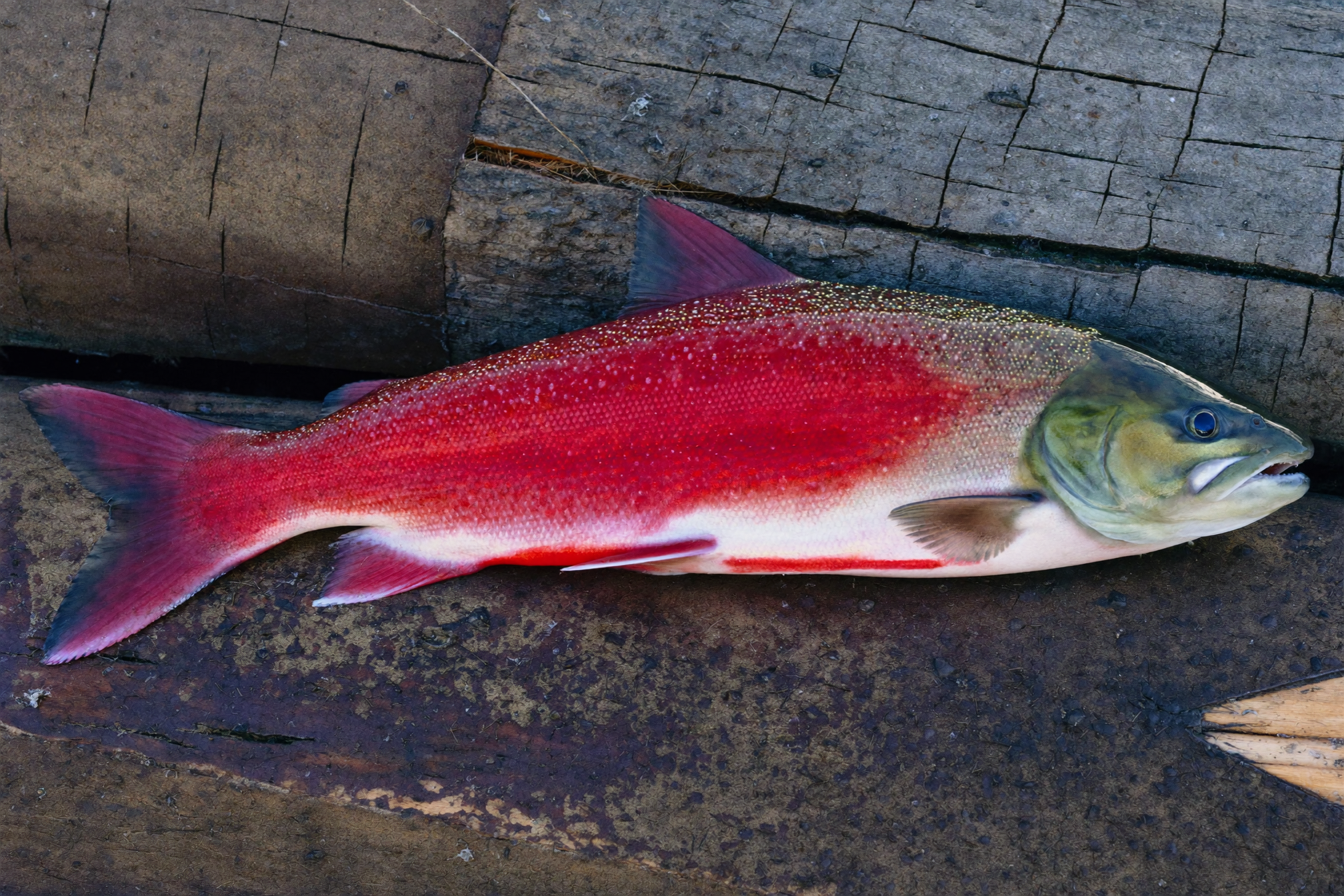
Sockeye salmon (Oncorhynchus nerka) is one of five species of Pacific salmon native to the cold, clean waters of the North Pacific and its tributary river systems. Known interchangeably as red salmon or blueback salmon, the sockeye earned its common names from the most striking characteristic of any salmonid: flesh so deeply red it borders on crimson, and a spawning transformation that turns its entire body a vivid scarlet.
Among Pacific salmon, sockeye occupy a fascinating middle ground. They are smaller than Chinook (king) salmon but larger than pink salmon, with most adults weighing 5 to 8 pounds and measuring 24 to 33 inches in length. What sockeye lack in size compared to their king salmon cousins, they more than make up for in color, flavor, and sheer abundance.
Species Quick Facts
Visual Identification
Sockeye salmon undergo one of the most dramatic visual transformations in the animal kingdom. In the ocean, they are sleek and streamlined with bright silver sides, metallic blue-green backs, and fine black speckling. They look almost indistinguishable from other Pacific salmon to an untrained eye.
But when sockeye begin their spawning migration — swimming hundreds of miles from the open ocean back to the exact freshwater stream where they were born — their bodies undergo a remarkable change. Males develop a pronounced hooked jaw (called a kype) and a humped back. Both sexes turn a striking deep red across their bodies while their heads shift to olive green. It is this spawning transformation that gives them the name “red salmon.”
Why the Flesh Is So Red
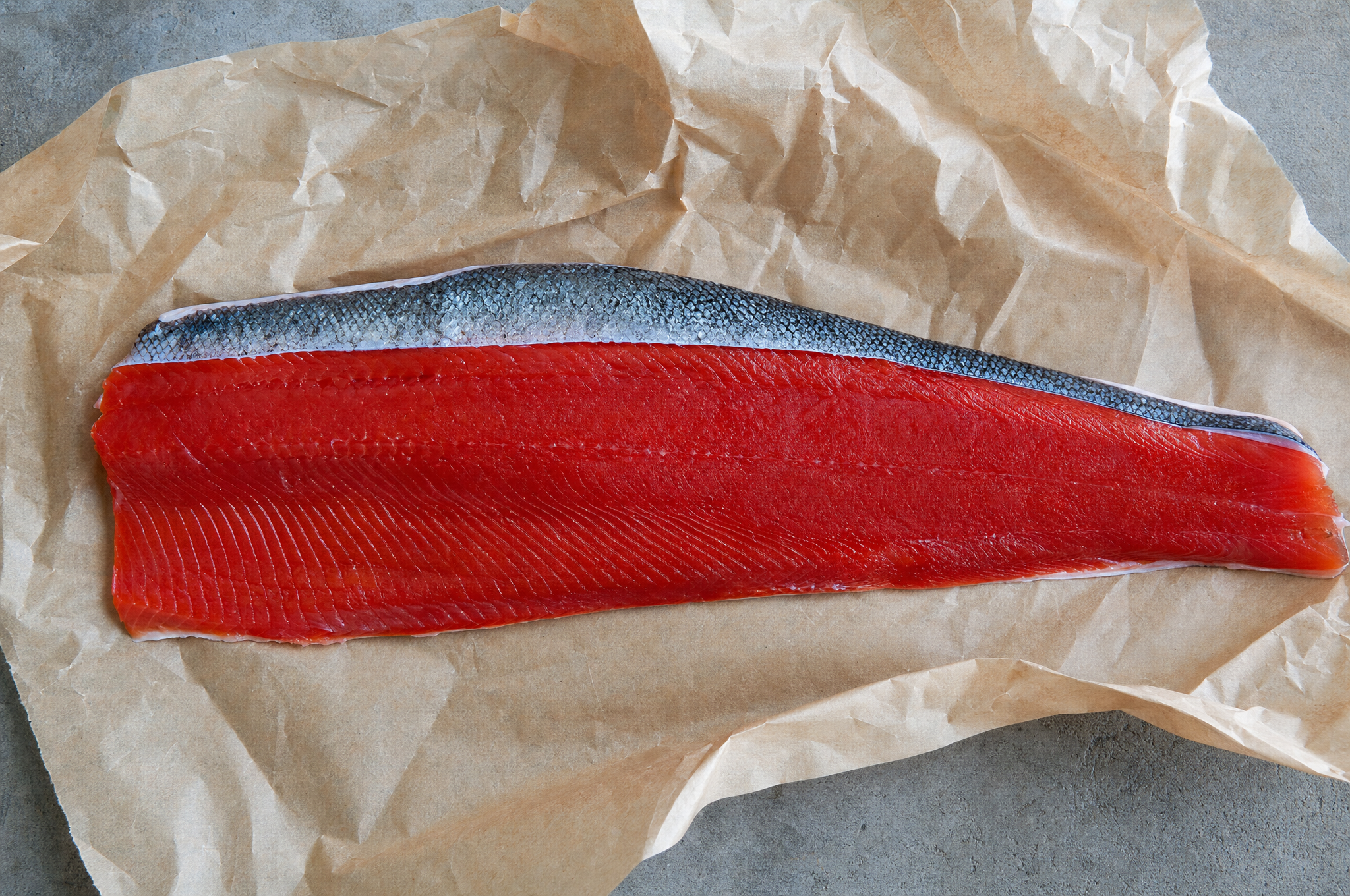
The defining feature of sockeye salmon is the deep red-orange color of its flesh — a natural result of the fish’s marine diet. While all wild salmon flesh contains some degree of pinkish-red pigment, sockeye stands apart because of its diet rich in krill, shrimp, and other small crustaceans that are loaded with a carotenoid pigment called astaxanthin.
Sockeye accumulate astaxanthin from their diet over their two to three years at sea, while farmed Atlantic salmon receive synthetic astaxanthin or canthaxanthin as a feed additive. The result is flesh that is naturally, unmistakably red. No dye. No additive. Just a wild diet doing what nature intended.
(We take a much deeper look at astaxanthin — what it is, what research is exploring, and the wild-versus-farmed debate — in the Astaxanthin Deep Dive section below.)
The Sockeye Lifecycle
Every wild sockeye salmon lives one of the most extraordinary life stories in the natural world — a round-trip journey of thousands of miles that begins and ends in the same freshwater stream. Understanding the lifecycle explains why these fish taste the way they do and why sustainable management matters so much.
Freshwater Birth (Year 0)
Sockeye eggs are deposited in gravel beds of freshwater streams and lakes, typically between July and September. Females select precise locations with clean gravel and steady water flow. The eggs incubate through winter, hatching in early spring as tiny alevins that feed on their attached yolk sacs.
Lake Rearing (Years 1–2)
Unlike most other Pacific salmon, juvenile sockeye typically spend one to two years rearing in freshwater lakes before heading to sea. During this stage they feed on zooplankton and insects, growing from fingerlings into silvery smolts ready for ocean migration. This lake-rearing stage is unique to sockeye and is one reason they require healthy lake ecosystems.
Ocean Migration (Years 2–4)
Smolts migrate downstream and enter the North Pacific Ocean, where they spend one to three years (usually two to three) feeding voraciously on krill, shrimp, squid, and small fish. This crustacean-heavy marine diet is what loads their flesh with astaxanthin and omega-3 fatty acids. Ocean-phase sockeye can travel thousands of miles across the Pacific.
The Homecoming (Year 4–5)
Guided by an astonishing sense of smell, adult sockeye navigate back across the ocean and up the exact river system where they were born. They stop feeding once they enter freshwater, relying entirely on stored body fat and muscle for energy. Their bodies transform from silver to deep red, and they fight upstream through rapids and shallow water to reach their natal spawning grounds.
Spawning & Legacy
Sockeye spawn in the same gravel beds where they were born, completing the cycle. After spawning, adult sockeye die within days to weeks. Their bodies decompose and deliver critical marine-derived nutrients (nitrogen, phosphorus, carbon) back into the freshwater ecosystem — feeding the forests, insects, and zooplankton that will nourish the next generation. It is nature’s most elegant nutrient cycle.
The Bristol Bay Fishery
Bristol Bay, Alaska is the epicenter of wild sockeye salmon on planet Earth. No other fishery comes close in scale, consistency, or sustainability. For anyone who cares about where their seafood comes from, Bristol Bay is the gold standard.
By the Numbers
The Bristol Bay sockeye run is the largest wild salmon run in the world, regularly producing 40 to 60+ million returning fish each year. In 2025, the inshore run totaled 56.7 million sockeye — the eleventh consecutive year the run exceeded 50 million fish. Of those, 41.2 million were commercially harvested while 15.5 million escaped to spawn, ensuring the health of future generations.
That 2025 harvest generated a preliminary ex-vessel value of over $215 million, supporting more than 14,000 commercial fishing jobs and dozens of coastal communities that depend on the annual run for their economic livelihood.
A Model for Sustainable Fisheries
The Alaska Department of Fish and Game (ADF&G) manages Bristol Bay sockeye under a strict “escapement first” policy: harvest is only permitted after enough fish have passed upstream to meet scientifically determined spawning targets. Every river system in the Bay has its own escapement goal, and managers make real-time, tide-by-tide decisions throughout the season to balance harvest opportunity with conservation.
This approach has sustained the fishery for well over a century. In 2025, every single escapement goal across Bristol Bay was met or exceeded. It is the longest-running example of science-based salmon management anywhere in the world.
Why Bristol Bay Matters to Popsie
Popsie Fish Co was founded by a Bristol Bay fisherman. Every piece of sockeye salmon we sell was caught by our family in these waters with set gillnets anchored off the beach at Egegik — the same method used here for generations. When you open a Popsie box, you are eating from the cleanest, most carefully managed fishery on the planet.
Flavor & Texture Profile
Sockeye salmon is the bold one. If king salmon is prized for its buttery richness and silky fat content, sockeye earns its following with intense, assertive, unmistakably salmon-forward flavor backed by firm, dense flesh that holds its shape under any cooking method.
The flavor of sockeye is often described as “clean” and “bright” with a pronounced savory depth that lingers. It has less marbled fat than king salmon, which means the salmon flavor itself takes center stage rather than being softened by richness. For people who love the taste of salmon — who want every bite to taste like the wild ocean — sockeye is the species.
The most intense, concentrated salmon flavor of any species. Clean and bright with natural depth — never fishy when properly handled.
Notably firmer than king or coho. Holds together beautifully on the grill, in a pan, or on a cedar plank. Won’t flake apart during cooking.
Leaner than king salmon (about 6 g fat and 970 mg EPA + DHA per 4 oz cooked serving). Less oily than king, more flavorful per bite.
If king salmon is the ribeye — marbled, buttery, luxurious — then sockeye is the filet mignon: leaner, more concentrated, all substance.
Why Chefs Love Sockeye
Professional kitchens gravitate toward sockeye for two practical reasons. First, the firm texture means it can be seared hard in a cast iron pan, laid directly on grill grates, or sliced thin for crudo without falling apart. Second, the deep red color makes for a stunning plate presentation that no other protein can match. There is no artificial coloring involved — just wild nature at its most vivid.
For home cooks, sockeye is the most forgiving salmon for grilling. Its dense flesh does not stick to grates as easily as fattier species, and it holds together when you flip it. That said, because sockeye is leaner than king salmon, it is less tolerant of overcooking — a topic we cover in detail in the Cooking Methods section.
Complete Nutritional Breakdown
Wild sockeye salmon is one of the most nutrient-dense foods on Earth. A single serving delivers an extraordinary spectrum of protein, healthy fats, vitamins, and minerals — many of them difficult to obtain from other dietary sources. Here is the complete picture based on USDA data.
| Nutrient | Per 4 oz (113 g) Cooked | % Daily Value |
|---|---|---|
| Calories | 176 kcal | — |
| Protein | 30 g | 60% |
| Total Fat | 6.3 g | 8% |
| Omega-3 (EPA + DHA) | About 970 mg | — |
| Vitamin B12 | 5.1 µg | 212% |
| Vitamin D | 18.9 µg (760 IU) | 94% |
| Selenium | 40 µg | 73% |
| Niacin (B3) | 11.4 mg | 71% |
| Vitamin B6 | 0.9 mg | 55% |
| Potassium | ~490 mg | 10% |
| Mercury | 0.022 ppm average for salmon (FDA does not list sockeye separately) | FDA “Best Choice” |
Nutritional data based on USDA FoodData Central values for cooked sockeye salmon (dry heat). Mercury data from FDA commercial fish monitoring (1990–2012). Percentages use FDA Daily Values; there is no Daily Value for omega-3s.
What Makes This Nutritional Profile Special
Three nutrients stand out. Vitamin B12 at about 212% of the Daily Value per 4 oz cooked serving makes sockeye one of the richest natural B12 sources available — critical for nerve function, red blood cell formation, and DNA synthesis. Vitamin D at about 94% of the Daily Value is remarkable because very few whole foods contain meaningful vitamin D. And the omega-3 fatty acids (EPA and DHA) come to about 970 mg per 4 oz cooked serving; the American Heart Association recommends 2 servings of fish (particularly fatty fish) a week.
Protein Quality
Sockeye salmon provides complete protein — all nine essential amino acids your body cannot produce on its own, in highly bioavailable form. The 30 grams per 4 oz cooked serving puts it on par with chicken breast, but with the added benefit of omega-3 fatty acids, vitamin D, and astaxanthin that chicken simply cannot deliver.
Mercury: Why Sockeye Is One of the Safest Fish
Salmon consistently tests among the lowest-mercury fish available. According to FDA monitoring data (1990–2012), fresh and frozen salmon average 0.022 ppm of mercury — compared to 0.350 ppm for canned albacore tuna and 0.995 ppm for swordfish. FDA does not list sockeye separately. Salmon’s low mercury levels are a function of its relatively small size, short lifespan, and plankton-and-crustacean diet. The FDA classifies all salmon in its “Best Choices” category: 2 to 3 servings a week for people who are pregnant or breastfeeding, and 2 age-sized servings a week for children ages 1–11.
Astaxanthin: The Sockeye Superpower
If you have ever wondered why sockeye salmon flesh is so deeply, vividly red, the answer is a single molecule: astaxanthin (pronounced asta-ZAN-thin). This naturally occurring carotenoid pigment is not just responsible for the color — it is also an antioxidant, and sockeye salmon contains more of it than any other commonly eaten fish.
What Is Astaxanthin?
Astaxanthin is a fat-soluble keto-carotenoid pigment produced by microalgae, particularly Haematococcus pluvialis. When krill and shrimp eat these algae, astaxanthin accumulates in their tissues. When sockeye salmon eat krill and shrimp by the billions during their two to three years at sea, astaxanthin concentrates in their muscle tissue — giving the flesh its signature deep red hue.
Astaxanthin as an Antioxidant
Astaxanthin is a natural antioxidant, and researchers continue to study what it does in the body.
Crucially, astaxanthin has no known pro-oxidant activity. Many antioxidants can flip and become pro-oxidants under certain conditions, potentially causing the very damage they are supposed to prevent. Astaxanthin does not exhibit this behavior, making it remarkably stable and safe.
Natural vs. Synthetic: The Wild Advantage
Here is where the wild-versus-farmed distinction becomes critically important. Wild sockeye salmon obtains its astaxanthin entirely from natural dietary sources — the krill and crustaceans it eats in the open ocean. Farmed Atlantic salmon, by contrast, would have gray flesh without the synthetic astaxanthin or canthaxanthin added to their feed pellets. These synthetic additives serve primarily a cosmetic function: they tint the flesh pink to match consumer expectations.
While synthetic astaxanthin is considered safe for consumption, the natural form found in wild sockeye is structurally identical to what the microalgae produce and what the salmon’s own biology evolved to process. When you eat wild sockeye, the astaxanthin in every bite arrived there the way nature designed.
Areas of Astaxanthin Research
- Skin health: Studies suggest astaxanthin may help protect against UV damage and improve skin elasticity, moisture, and appearance of fine lines.
- Eye health: Astaxanthin can cross the blood-retinal barrier, and research has explored its potential role in reducing eye fatigue and supporting visual acuity.
- Exercise recovery: Some evidence suggests astaxanthin may help reduce exercise-induced oxidative stress and support faster muscle recovery.
- Inflammation: Astaxanthin appears to modulate inflammatory pathways, with potential applications in joint health and general inflammatory management.
- Cardiovascular support: Early research suggests potential benefits for lipid profiles and blood flow.
Health Benefits of Wild Sockeye Salmon
Wild sockeye salmon’s unique combination of omega-3 fatty acids, complete protein, astaxanthin, vitamin D, vitamin B12, and selenium makes it one of the most health-promoting whole foods you can eat. Here is a summary of the key health benefits supported by nutritional science.
Heart Health
Eating fish is linked to a lower risk of dying from heart disease: a 2006 JAMA review found 1–2 servings a week, especially of fish higher in EPA and DHA, associated with 36% lower coronary death (Mozaffarian & Rimm). The American Heart Association recommends eating fish (particularly fatty fish like salmon) at least twice per week.
Brain Health & Cognition
DHA is especially concentrated in the brain and retina. Eating fish is associated with healthier brain aging: in one study of older Chicago adults, eating fish at least once a week was linked to a 60% lower risk of Alzheimer disease (Morris et al., 2003).
Inflammation & Joint Health
In trials of omega-3 supplements (not fish meals), 3–4 months of supplementation modestly reduced joint pain and morning stiffness in rheumatoid arthritis (Goldberg & Katz, 2007).
Bone & Immune Health
With about 94% of the Daily Value for vitamin D in a 4 oz cooked serving, sockeye helps support calcium absorption, bone density, and immune system function. Few whole foods contain much vitamin D, and USDA lists sockeye highest of the salmon it measures.
Pregnancy & Early Development
DHA is critical for fetal brain and eye development, particularly during the third trimester. The FDA and EPA recommend that pregnant and breastfeeding women eat two to three servings per week of fish from the “Best Choices” list — and all salmon, including sockeye, is on that list. Salmon’s very low mercury content (fresh and frozen salmon average 0.022 ppm in FDA testing) makes it one of the safest fish options during pregnancy.
Note: Pregnant women should always consult their healthcare provider for personalized dietary guidance.
Want the Full Picture?
We dive much deeper into the science of omega-3s, vitamin D, and salmon’s role in heart health, brain health, and more in our comprehensive Health Benefits of Wild Alaskan Salmon pillar page. Much of this section applies to other wild salmon too — sockeye just happens to deliver it with the highest astaxanthin content of any salmon you can buy.
Best Cooking Methods for Sockeye Salmon
Sockeye’s firm, dense flesh and lean-but-flavorful profile make it exceptionally versatile. It holds together on the grill, sears beautifully, and takes well to smoking, baking, and raw preparations.
Sockeye is leaner than king, so overcooking is less forgiving. Many cooks pull it at 120–125°F internal for medium-rare (it carries over a few degrees while resting). The FDA recommends cooking seafood to 145°F, and pregnant women, young children, older adults and anyone with a weakened immune system should follow that advice. An instant-read thermometer is the single best investment for cooking fish.
Grilling
Sockeye’s firm flesh makes it ideal for grilling — it holds together on direct heat. Oil grates well, preheat to medium-high, and place fillets skin-side down for 3–4 minutes to build a char. Flip once and cook 2–3 minutes more.
Cedar plank: Soak a plank 1+ hour, place sockeye skin-side down over medium heat, close lid, and cook 12–15 minutes. The plank adds smoky sweetness that pairs well with sockeye.
Pan-Searing
A sockeye classic. Pat fillets bone-dry (moisture prevents a good sear). Heat a cast iron skillet over medium-high with high-smoke-point oil. Place skin-side down, press gently 30 seconds to prevent curling, and cook 3–4 minutes until crisp. Flip and cook 2–3 minutes more.
Finish with a knob of butter, a squeeze of lemon, and fresh dill. The skin should shatter like a cracker.
Baking
Preheat to 400°F. Place seasoned fillets on a parchment-lined sheet pan, skin-side down. Bake 10–12 minutes (adjust for thickness). The oven’s even heat is forgiving and consistent.
Glaze options: Teriyaki, honey-soy-ginger, lemon-dill-butter, miso-maple, or a simple olive oil and herb crust. Apply glaze before baking or brush on halfway through for a glossy finish.
Smoking
Sockeye is Alaska’s go-to for smoked salmon — its lean flesh absorbs smoke well and its firm texture holds together. Brine 8–12 hours (salt, brown sugar, water), air-dry until a pellicle forms, then smoke.
Hot smoke: 175–200°F for 2–3 hours using alder, cherry, or apple wood. Cold smoke: Below 90°F for 12–24 hours (requires specialized equipment and food safety knowledge).
Poaching
Poaching is the gentlest cooking method and virtually eliminates the risk of overcooking. Prepare a court-bouillon (water, white wine, lemon, peppercorns, bay leaf, dill) and bring to a bare simmer. Submerge sockeye fillets and poach at 160–170°F for 8–10 minutes. The result is silky, evenly cooked flesh that works beautifully in salads or served cold.
Air Fryer
The air fryer produces a crisp exterior with a moist interior in under 10 minutes — making it a fantastic weeknight option. Preheat to 380°F. Lightly oil and season the fillet, place skin-side down in the basket, and cook 8–10 minutes depending on thickness. No flipping needed. The circulating hot air crisps the top while the skin protects the bottom.
Common Mistakes to Avoid
- Overcooking: The number-one mistake. Sockeye has less fat than king, so it dries out faster past 130°F internal. Many cooks pull it at 120–125°F and let it rest 3–5 minutes; the FDA recommends cooking seafood to 145°F, and pregnant women, young children, older adults and anyone with a weakened immune system should follow that advice.
- Skipping the dry step: Wet fish will not sear. Pat every fillet bone-dry with paper towels before it touches the pan or grill.
- Cooking from frozen: While it is possible, thawing first always produces a better result. Frozen fillets release excess moisture that prevents proper searing.
- High heat the entire time: Start hot to build a crust, then moderate the heat to finish gently. This prevents a burned exterior with a raw center.
- Fussing with it: Let the fillet sit undisturbed. Moving it too early breaks the crust and causes sticking.
For detailed step-by-step instructions and specific sockeye recipes for each method, visit our Recipe Collection.
How to Buy Wild Sockeye Salmon
One of the unique things about sockeye salmon is that virtually all of it is wild-caught. Unlike Atlantic salmon (which is overwhelmingly farmed), there is no significant commercial farming of sockeye. When you see “sockeye salmon” in a market, you can be almost certain it was caught wild from the Pacific.
What to Look For
- Deep red-to-crimson color. The hallmark of quality sockeye is rich, saturated red flesh. Pale or dull color may indicate age or improper handling.
- Firm, springy flesh. Press the fillet gently — it should bounce back, not leave an indentation. Mushy or soft texture is a sign of breakdown.
- Clean, ocean-fresh smell. Fresh or properly frozen sockeye should smell like the sea — clean and briny. Any strong “fishy” or ammonia-like odor means it is past its prime.
- “Wild-caught” or “Wild Alaskan” on the label. While almost all sockeye is wild, confirming origin ensures you are getting the real thing.
- Bristol Bay origin (when possible). Bristol Bay is the world’s largest and most sustainably managed sockeye fishery. If you can find it, this is the gold standard.
- Vacuum-sealed for frozen. Quality frozen sockeye should be individually vacuum-sealed with no visible ice crystals or freezer burn.
Bristol Bay vs. Copper River vs. Other Sources
Copper River sockeye gets enormous marketing attention (and higher prices) each spring when the first fish arrive. Bristol Bay produces 40–60+ million fish/year vs. ~1–2 million. Both are excellent; Bristol Bay’s scale and management make it the better value.
Common Cuts
- Skin-on fillets: Most popular. Skin crisps beautifully when seared.
- Portions: Pre-cut 5–7 oz pieces, ideal for meal planning.
- Whole sides: Great for entertaining or making your own cuts.
- Steaks: Cross-cut, bone-in. Excellent for grilling.
Popsie’s Wild Sockeye Salmon
Every piece of sockeye we sell is Bristol Bay wild-caught, flash-frozen within hours of harvest, and vacuum-sealed for peak freshness. Our portions and fillets ship directly to your door.
Our 10 lb Value and 15 lb Family box-size options are designed for households that want to keep more wild Alaskan seafood on hand. Check the live product page for current contents and pricing. Build your custom box in our shop.
Storage & Thawing Guide
Properly handled frozen wild sockeye salmon keeps its best quality for 6–12 months. The key to great results is understanding how to store it and — just as importantly — how to thaw it correctly.
Frozen Storage
Vacuum-sealed sockeye keeps its best quality for 6–12 months at 0°F or below. Keep deep in the freezer (not in the door) for the most consistent temperature.
Refrigerator Thaw
Recommended method. Open or remove the vacuum packaging first. Place the sockeye in a shallow covered container, keep it refrigerated, and follow any package or processor instructions.
Cold Water Thaw
For faster results, submerge sealed fillets in cold water, changing the water every 30 minutes. Sockeye portions thaw in 1.5–2 hours. Cook immediately after thawing.
Once thawed, sockeye salmon should be cooked within 1–2 days and stored in the refrigerator on the coldest shelf. Do not refreeze previously frozen fish — it degrades texture and moisture. For best results, thaw only what you plan to cook that day or the next.
Sockeye vs. Other Salmon Species
Not all salmon is created equal. Each species has its own flavor profile, fat content, texture, and ideal cooking applications. Here is how sockeye stacks up against the salmon you are most likely to find at market.
| Attribute | Sockeye (Red) | King (Chinook) | Coho (Silver) | Pink (Humpback) | Farmed Atlantic |
|---|---|---|---|---|---|
| Flavor | Bold, salmon-forward | Rich, buttery | Mild, delicate | Very mild, light | Mild, fatty |
| Texture | Firm, dense | Silky, buttery | Medium-firm | Soft, fine | Soft, oily |
| Flesh Color | Deep red (natural) | Orange-red | Red-orange | Light pink | Pink (dyed feed) |
| Fat (4 oz cooked) | ~6 g | ~15 g | ~5 g | ~6 g | ~14 g |
| EPA + DHA (4 oz cooked) | ~970 mg | ~1,960 mg | ~1,200 mg | ~700 mg | ~2,400 mg |
| Avg. Size | 5–8 lbs | 10–50 lbs | 6–12 lbs | 3–5 lbs | 8–12 lbs |
| Mercury | Low (FDA salmon average 0.022 ppm) | Low (same FDA salmon average) | Low (same FDA salmon average) | Low (same FDA salmon average) | Low (same FDA salmon average) |
| Best For | Grilling, searing, smoking | Sashimi, baking, luxury occasions | Baking, beginners | Canning, fish cakes | Everyday use (budget) |
| Wild / Farmed | ~100% wild | Mostly wild | Mostly wild | ~100% wild | ~99% farmed |
Sockeye vs. King: The Big Comparison
King salmon is the largest Pacific species with rich, buttery flesh. Sockeye is leaner but delivers bolder flavor, deeper red color, and more astaxanthin. King is the special-occasion fish; sockeye is the everyday powerhouse — bold flavor, firm texture, outstanding nutrition, and better per-pound value for families.
Sockeye vs. Farmed Atlantic
Farmed Atlantic accounts for 70%+ of all salmon sold globally. The key differences:
- Color: Sockeye’s red is 100% natural. Farmed Atlantic gets pink color from synthetic feed additives.
- Nutrition: Sockeye is leaner (133 vs. 175 calories per 3 oz cooked) with a higher omega-3 to omega-6 ratio; USDA lists farmed Atlantic higher in total EPA + DHA because it is much fattier.
- Purity: Wild sockeye is never given antibiotics and never lives in crowded net pens. A 2004 study found organochlorine contaminants “significantly higher in farmed salmon” than in wild (Hites et al., Science).
- Sustainability: Bristol Bay has 130+ years of sustainable management. Salmon farms raise concerns about sea lice and waste.
- Taste: Sockeye delivers assertive, clean flavor. Farmed Atlantic tastes milder with less depth.
From Bristol Bay to Your Table
There is nothing like being on the water when the sockeye run hits Bristol Bay. Millions of fish returning to the exact stream where they were born. When you pull a sockeye from the net, the deep red color hits you. That is the fish I built Popsie around.— Tony, Founder & Bristol Bay Fisherman, Popsie Fish Co
The Largest Wild Salmon Run on Earth
Bristol Bay in southwest Alaska is where nine major river systems create one of the most productive marine ecosystems on the planet. Every summer, tens of millions of sockeye return to spawn. In 2025, the run totaled 56.7 million fish — the eleventh consecutive year exceeding 50 million.
How Popsie Harvests Sockeye
Our family harvests sockeye with set gillnets anchored off the beach at our Egegik fish camp, picking every fish by hand, bleeding it at once, and slush-icing it before it goes up the beach by four-wheeler to the processor. Fish are processed within hours — cleaned, filleted, flash-frozen, and vacuum-sealed. Ocean to frozen in under 24 hours.
Sustainability & Community
Alaska’s constitution mandates sustainable fisheries management. ADF&G enforces strict escapement goals — fishing is only permitted after enough sockeye have passed upstream to spawn. The fishery has sustained commercial harvest for over 130 years without collapse, supporting 14,000+ jobs and $215M+ in ex-vessel value.
Our Promise
Every sockeye from Popsie came from the cleanest waters on Earth, harvested by fishermen who stake their livelihoods on this fishery’s health. Choosing Popsie means voting for wild, sustainable seafood.
Sockeye Salmon Seasonal Calendar
Sockeye is seasonal, but flash-freezing means peak quality year-round.
The Bristol Bay season runs late June through mid-July. Pre-season orders open in May. Because Popsie’s sockeye is flash-frozen within hours of harvest, you can order year-round. Flash-frozen sockeye is nutritionally identical to fresh.
Sockeye Salmon Recipes
Our favorite sockeye recipes, organized by method.
Frequently Asked Questions
Sockeye has the boldest flavor of any salmon — intensely salmon-forward with a clean finish. Leaner than king with more concentrated flavor, it is the top choice for true salmon lovers.
The deep red comes from astaxanthin, a carotenoid pigment from eating krill and crustaceans. Wild sockeye contains more of it than any other salmon. No dyes involved.
Sockeye delivers the most natural astaxanthin of any salmon, plus about 212% of the Daily Value for B12, about 94% for vitamin D, and about 970 mg of EPA + DHA omega-3s per 4 oz cooked serving (USDA). USDA lists more vitamin D in sockeye than in any other salmon it measures; king, coho and farmed Atlantic have more EPA + DHA.
Many cooks pull it from the heat at 120–125°F internal; the FDA recommends cooking seafood to 145°F, and pregnant women, young children, older adults and anyone with a weakened immune system should follow that advice. Pat dry, sear skin-side down, rest 3–5 minutes. Use an instant-read thermometer.
King is larger (10–50 lbs), fattier, and buttery. Sockeye is leaner, firmer, with bolder flavor and deeper red color. King excels in sashimi; sockeye excels at grilling and smoking.
Yes — we sell our sockeye as sashimi-grade. “Sushi-grade” is not a government-regulated term; what matters is how the fish is handled and frozen. Our sockeye is bled at capture and flash-frozen to meet the FDA’s parasite-destruction freezing guidance for fish eaten raw, the same standard sushi restaurants rely on. Thaw it in the refrigerator, keep it cold, and use it within 24 hours for sashimi, poke, or crudo. Freezing controls parasites, not bacteria, so the FDA advises pregnant women, young children, older adults and anyone with a weakened immune system to eat seafood cooked to 145°F.
Vacuum-sealed sockeye keeps its best quality for 6–12 months at 0°F or below. After thawing, cook within 1–2 days.
No. In FDA testing, fresh and frozen salmon average 0.022 ppm mercury (FDA does not list sockeye separately) — far below canned albacore tuna (0.350 ppm) and swordfish (0.995 ppm). FDA and EPA list salmon as a “Best Choice”: 2–3 servings a week in pregnancy and breastfeeding, and 2 age-sized servings a week for children 1–11.
Ready to Taste the Difference?
Wild Bristol Bay sockeye, flash-frozen at peak freshness and shipped to your door.