HomeGuides › Buying & Storage Guide
Popsie Fish Co — Buying Guide

How to Buy Wild Salmon: The Complete Buying & Storage Guide

Everything you need to know about choosing the right species, reading labels, storing properly, and getting the best value on wild-caught salmon — whether you are shopping at the grocery store or ordering direct.

Key Takeaways

  • Flash-frozen wild salmon is often fresher than “fresh” fish at the counter — it is locked in at peak quality within hours of harvest, while counter fish may be 5–10 days old.
  • All “Atlantic salmon” is farmed — always look for “Pacific” or “Alaskan” on the label if you want truly wild-caught fish.
  • Direct-to-consumer ordering eliminates middleman markups — you pay less per pound for higher-quality fish than most grocery stores offer.
  • Vacuum-sealed wild salmon keeps 6–9 months at peak quality in your freezer — stock up when you find a great price and eat well for months.
  • The right thawing method matters more than the right cooking method — overnight refrigerator thaw preserves texture and flavor best.
  • Eating salmon 2–3 times per week is recommended by the AHA — at that rate, a 10 lb box lasts a family of four about 3–4 weeks.

1. Why Choosing the Right Salmon Matters

Salmon is the most popular seafood in America after shrimp — but not all salmon is created equal. The difference between a carefully sourced wild-caught fillet and a randomly chosen package at the grocery store can be enormous in terms of flavor, nutrition, environmental impact, and value for your dollar. Knowing how to buy salmon well is a skill that pays off every time you cook.

The Health Argument

Wild Pacific salmon is one of the most nutrient-dense foods on the planet. A single 6 oz serving delivers 1,200–3,800 mg of omega-3 fatty acids (depending on species), 40+ grams of protein, and exceptional amounts of vitamin D, B12, and selenium. The American Heart Association recommends eating fish — particularly fatty fish like salmon — at least twice per week for cardiovascular health. But the nutritional profile varies significantly by species and by whether the fish is wild or farmed.

Wild salmon gets its omega-3s from a natural diet of krill, herring, and other marine life. Farmed salmon gets its fat from processed feed pellets, resulting in a different fatty acid profile with higher omega-6 content and a less favorable omega-3 to omega-6 ratio. Choosing wild means choosing the nutritional profile your body was designed to benefit from.

The Flavor Argument

Wild-caught salmon tastes different from farmed — and most people who try both side by side prefer wild. Wild salmon has a cleaner, more complex flavor with species-specific character: king is rich and buttery, sockeye is bold and meaty, coho is mild and delicate. Farmed Atlantic salmon has a uniform, mild taste that many describe as flat by comparison. The difference comes down to diet and environment — a fish that swims thousands of miles through the open Pacific, eating what nature provides, develops a depth of flavor that a pen-raised fish simply cannot replicate.

The Environmental Argument

Alaska’s wild salmon fisheries are among the best-managed in the world. The state constitution mandates sustainable-yield management. Every run is monitored in real time with sonar counts, and fishing only opens when enough fish have passed upstream to meet spawning goals. There are no dams on Bristol Bay rivers, no industrial development, and no fish farms in Alaska — commercial salmon farming has been banned in the state since 1990.

By contrast, salmon farming operations in Norway, Chile, Scotland, and British Columbia have been documented raising concerns about environmental impact, including waste discharge, disease transfer to wild populations, escapement, and use of antibiotics. Buying wild Alaskan salmon is a vote for the most sustainable model of protein production on Earth.

Wild Salmon Species 5 Pacific
Omega-3s Per Serving 900–2,200 mg
AHA Recommendation 2–3x / Week
Protein Per 6 oz 34–42 g
Mercury Level Very Low
Freezer Life (Sealed) 6–9 Months

2. Which Salmon Is Right for You?

There are five species of Pacific salmon, plus wild halibut — and each has a distinct personality. The right choice depends on your taste preferences, cooking style, and budget. Use this quick decision guide to find your ideal match, then explore the detailed comparison below.

Want Rich & Buttery? King Salmon The luxury choice. Highest fat, biggest flakes, most omega-3s. Best for grilling, searing, and special occasions. See how king compares to sockeye →
Want Bold & Vibrant? Sockeye Salmon Deep red flesh, assertive flavor, firm texture. The best all-around wild salmon for health-conscious cooks.
Want Mild & Versatile? Coho Salmon Delicate flavor, tender flakes, approachable taste. Ideal for families and picky eaters. See how coho compares to sockeye →
Want Affordable & Light? Pink Salmon Lightest flavor, lowest price, softer texture. Great for salmon burgers, salads, and budget meals. See how pink compares to sockeye →
Want Firm White Fish? Halibut Mild, sweet, ultra-firm. A completely different experience from salmon. Perfect for fish tacos, pan-searing, and people who think they don’t like fish.
Can’t Decide? Mix & Match Build a custom Popsie box with sockeye, halibut, cod, and sablefish. Try a variety, find your favorites, and save more the more you order.

Species Comparison at a Glance

Attribute King Sockeye Coho Pink Halibut
Flavor Rich, buttery Bold, meaty Mild, delicate Light, subtle Mild, sweet
Texture Large flake, silky Firm, dense Medium flake, tender Soft, fine flake Ultra-firm, lean
Omega-3s (3 oz) ~2,200 mg ~1,500 mg ~1,200 mg ~900 mg ~400 mg
Fat Content Highest (~10%) Moderate (~5%) Moderate (~6%) Low (~3.5%) Very low (~2.5%)
Best For Special occasions Everyday health Family dinners Budget meals Fish tacos, searing
Cooking Ease Very forgiving Moderate Forgiving Easy Watch closely
Flesh Color Red / ivory Deep red Orange-red Light pink White

Not sure where to start? Most first-time wild salmon buyers love sockeye — it delivers the classic salmon experience with bold color, rich flavor, and excellent nutrition at a mid-range price point. If you want to explore, Popsie’s mix-and-match system lets you combine species in one box so you can discover your favorites without committing to 10 pounds of a single fish.

3. Price Comparison by Species

Wild salmon prices vary significantly by species, source, and season. Here is a realistic breakdown of what you can expect to pay across the most common buying channels. These ranges reflect typical retail pricing for wild-caught Alaskan fish — not sale prices, not farmed, and not imported.

Species Grocery Store (per lb) Warehouse Club (per lb) Online / DTC (per lb) Value Rating
King Salmon $30–$50 $25–$38 $22–$35 Premium
Sockeye Salmon $18–$30 $14–$22 $13–$20 Best balance
Coho Salmon $16–$25 $12–$18 $12–$18 Great value
Pink Salmon $8–$14 $6–$10 $7–$12 Budget-friendly
Halibut $25–$40 $20–$32 $18–$28 Premium

Notice that direct-to-consumer pricing consistently comes in at or below warehouse club prices — often for a higher-quality product that was flash-frozen at sea instead of thawed and displayed at a counter. The DTC model eliminates distributors, brokers, and retail markup, passing those savings directly to you.

The real cost comparison isn’t per pound — it’s per serving. A 6 oz portion of wild sockeye at $16/lb works out to roughly $6 per serving — less than a fast-food combo meal and far more nutritious. When you factor in the omega-3s, protein, and micronutrients, wild salmon is one of the best values in the entire grocery store.

Build Your Custom Box

4. How to Read Seafood Labels Like a Pro

Seafood labeling can be confusing — and sometimes deliberately so. Vague terms, missing information, and misleading claims are common. Here is how to decode what you are actually buying.

“Wild-Caught” or “Wild”

These terms mean the same thing: the fish was harvested from its natural habitat, not raised in a farm or pen. For Pacific salmon species (king, sockeye, coho, pink, chum), this is the standard. Nearly all Pacific salmon sold in the U.S. is wild-caught.

Trustworthy

“Atlantic Salmon”

This is the single most important label to understand. All Atlantic salmon sold commercially is farmed. Wild Atlantic salmon is critically endangered and not commercially harvested. If a label says “Atlantic salmon,” it came from a farm — period. It does not matter if it also says “fresh” or “natural.”

Always Farmed

“Pacific Salmon”

Usually wild-caught, but always check. The vast majority of Pacific salmon is wild, but some Pacific Chinook (king) salmon is farmed in New Zealand and occasionally elsewhere. Look for a country of origin — if it says Alaska or USA, it is wild.

Usually Wild

“Sustainably Sourced”

This term has no legal definition and is essentially meaningless without a third-party certification behind it. Look instead for MSC (Marine Stewardship Council) certification — the gold standard for wild fisheries. Alaska’s salmon fisheries are MSC-certified. The terms ASC and BAP apply to farmed fish.

Verify Certification

“Previously Frozen”

This label is required when fish sold at the “fresh” counter was actually frozen and then thawed for display. Nearly all wild salmon at grocery store counters was previously frozen — it just may not always be labeled clearly. This fish has already used up some of its shelf life during thawing and display time.

Know What You’re Buying

Country of Origin (COOL)

U.S. law requires Country of Origin Labeling on seafood. What to look for: USA / Alaska = wild, well-managed fisheries. Norway, Chile, Scotland = almost certainly farmed. China = often wild-caught Alaska fish that was shipped to China for processing and re-imported. This adds thousands of food miles and raises quality concerns.

Always Check

The “Product of China” Problem

A significant portion of wild Alaskan salmon is shipped to China for processing — the fish is filleted, portioned, and repackaged, then shipped back to the United States for sale. While the fish itself may be genuinely wild-caught in Alaska, this round-trip journey adds weeks to the supply chain, increases the carbon footprint dramatically, and raises questions about processing standards. The label will say “Product of China” or “Processed in China.”

Popsie’s fish is caught in Bristol Bay, processed in Alaska, and shipped directly to your door. No round trips. No third-country processing. The shortest possible chain from ocean to plate.

Certification Guide

Certification What It Means Applies To Trustworthiness
MSC (Marine Stewardship Council) Third-party verified sustainable fishing practices; stock health, ecosystem impact, and management assessed Wild fisheries Gold standard
ASC (Aquaculture Stewardship Council) Environmental and social standards for farmed fish operations Farmed fish only Good for farmed
BAP (Best Aquaculture Practices) Covers farmed operations across the supply chain from hatchery to processing Farmed fish only Good for farmed
Alaska RFM (Responsible Fisheries Mgmt) Alaska-specific sustainability certification using FAO guidelines Alaska wild fisheries Very high
“Sustainably Sourced” (no logo) Marketing claim with no third-party verification or legal standard Anything Unverified

5. Fresh vs. Frozen: Why Frozen Often Wins

This is the single biggest misconception in seafood buying. Most people assume that “fresh” fish at the counter is superior to frozen. For wild salmon, the opposite is usually true.

The Cold Chain Explained

Wild salmon is caught in remote Alaskan waters — often hundreds of miles from the nearest road, let alone an airport. Here is what happens to that fish depending on which path it takes to your kitchen:

The “Fresh” Counter Path

Day 0: Fish is caught and chilled on ice on the boat.

Day 1–2: Delivered to a shore-side processor. Filleted and packed on ice.

Day 2–3: Shipped by air to a distributor in the lower 48 states.

Day 3–5: Distributed to regional warehouses, then to individual store locations.

Day 5–10: Displayed at the fish counter on ice, slowly degrading until purchased.

Total time from catch to your kitchen: 5–12 days. Quality declining every day.

The Flash-Frozen Path

Day 0: Fish is caught and immediately bled and chilled on the boat.

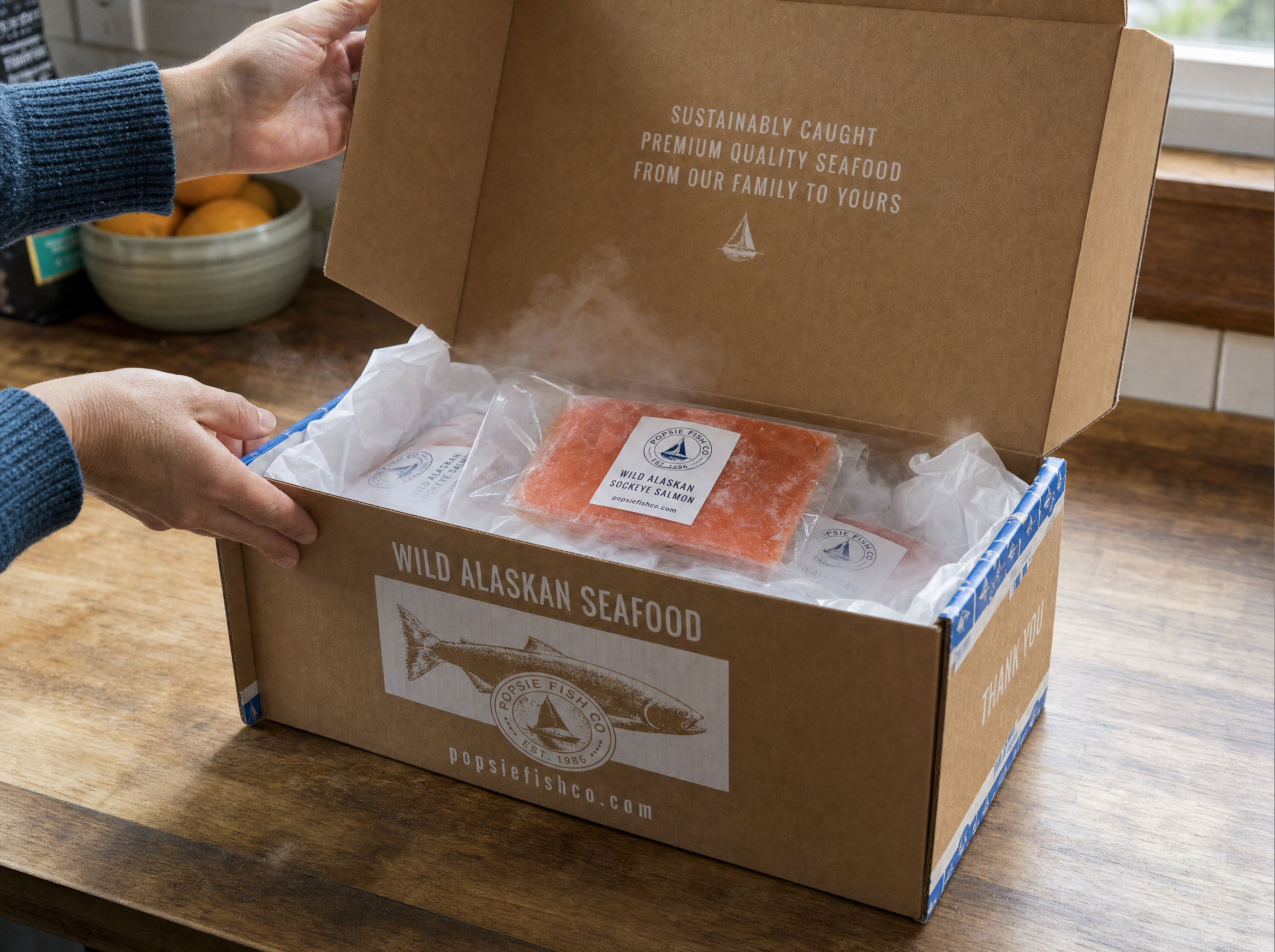
Hours later: Delivered to a shore-side processor. Filleted, vacuum-sealed, and flash-frozen at -40°F within hours of harvest.

Frozen state: All biological processes stop. The fish is locked in at peak freshness. It can be stored and shipped without quality loss.

At your home: You thaw the fish overnight. The clock restarts from nearly zero.

Effective freshness when you cook it: hours old, not days.

The Nutritional Truth

Multiple studies, including those referenced by the USDA, have confirmed that properly flash-frozen fish retains virtually identical nutritional content to never-frozen fish. Omega-3 fatty acids, protein, vitamins, and minerals are all preserved through the freezing process. The only measurable difference is a small amount of moisture loss during thawing — and even that is minimal with vacuum-sealed packaging and proper thawing technique.

Why Sushi Restaurants Prefer Frozen Fish

Here is a fact that surprises many people: the FDA actually recommends that all fish intended for raw consumption (sushi, sashimi, crudo) be previously frozen to kill parasites. Freezing to -4°F for 7 days or -31°F for 15 hours eliminates the risk of parasitic infection. This means that the best sushi restaurants in the country are serving previously frozen fish — and they choose to do so because the quality is excellent.

Bottom line: When someone at a grocery store tells you their salmon is “fresh, never frozen,” ask them when it was caught. If they cannot tell you, or if the answer is more than 3 days ago, that fish is less fresh than a properly frozen fillet you thaw at home. Flash-freezing is not a compromise — it is a technology that delivers peak-quality fish regardless of where you live or what time of year it is.

Fresh vs. Frozen: Side-by-Side

Factor “Fresh” Counter Fish Flash-Frozen at Sea
Actual freshness 5–12 days post-catch Hours post-catch (frozen at peak)
Nutrient retention Declining daily Locked in at harvest
Texture quality Softening over time Preserved until thaw
Price per pound Higher (logistics cost) Lower (efficient shipping)
Shelf life at home 1–2 days 6–9 months frozen
Availability Seasonal / inconsistent Year-round
Safe for raw prep Risky without freezing step FDA-compliant for raw consumption
Overall quality Variable Consistently high

6. Where to Buy Wild Salmon

You have more options than ever for buying wild salmon. Each channel has trade-offs in terms of quality, price, convenience, and selection. If you are still deciding which species to try first, our complete guide to Alaska seafood species covers flavor profiles, nutrition, and best uses for every wild-caught option. Here is an honest breakdown of your buying options.

Direct-to-Consumer (Popsie’s Model)

Fish goes from the fishing boat to a shore-side processor to your freezer — no distributors, no grocery store markup, no sitting on a display counter. You get the shortest supply chain, the freshest product, and the best per-pound value, especially at higher volume tiers.

Best for: Quality-focused buyers, families who eat salmon regularly, anyone who wants to stock their freezer and save.

Best Quality + Value

Grocery Store Fish Counter

Convenient, but the quality is inconsistent. Most “fresh” wild salmon at the counter was previously frozen and thawed for display — meaning it is already partway through its shelf life when you buy it. Selection varies by season and region. Pricing includes significant markup for the retailer and the logistics of maintaining a staffed fish department.

Best for: Same-day meals when you need fish now and cannot plan ahead.

Tips: Ask when the fish was delivered. Check for “previously frozen” labels. Look for firm flesh that springs back when pressed. Smell it — it should smell clean and oceanic, never ammonia-like.

Convenient but Variable

Warehouse Clubs (Costco, Sam’s Club)

Often the best grocery option for wild salmon. Warehouse clubs move high volume, which means faster turnover and fresher product. Costco in particular has a strong reputation for sourcing quality wild salmon, and their pricing is consistently lower than traditional grocery stores. Frozen wild salmon fillets are a reliable choice.

Best for: Buyers who prefer in-store shopping and want better pricing than grocery stores.

Tips: The frozen section often has better quality and value than the fresh counter. Look for vacuum-sealed wild sockeye fillets.

Good Quality + Price

Farmers’ Markets

Some farmers’ markets feature direct-from-fishermen vendors, especially in coastal areas and the Pacific Northwest. This can be an excellent source of high-quality wild salmon during the harvest season (June–September). Availability is seasonal and geographic — inland markets rarely have reliable fish vendors.

Best for: Seasonal purchases, meeting the people who catch your fish, supporting local fishermen.

Seasonal / Regional

Online Seafood Retailers

A growing category with a wide range of quality. Some online retailers source directly from Alaska fishermen (like Popsie does). Others are simply middlemen who buy from the same suppliers as grocery stores and add their own markup. The key differentiators are sourcing transparency, processing location, and whether the company has a direct connection to the fishery.

What to compare: Where is the fish caught? Where is it processed? Is it flash-frozen or slow-frozen? What is the per-pound price at different quantities? What are the shipping costs?

Varies Widely

Why DTC Is the Best Value

Every step in the traditional seafood supply chain adds cost: the broker, the distributor, the retailer’s margin, the fish counter staff, the shrink from unsold product. By the time wild salmon reaches a grocery store counter, these markups can add 40–100% to the original price without improving quality.

The DTC model removes all of these intermediaries. Popsie’s fish goes from Bristol Bay to a processing plant to your door. You pay for the fish, the processing, and the shipping — that is it. And because frozen fish ships efficiently and does not spoil, there is zero shrink.

Lowest True Cost

The math is simple: A pound of wild sockeye at a grocery store counter runs $18–$30. That same quality of fish from Popsie, flash-frozen at peak freshness and delivered to your door, runs $13–$20 per pound depending on your box size — and it is objectively fresher because it was frozen within hours of harvest instead of sitting on ice for a week.

Skip the Middleman — Order Direct How Popsie Works

7. Freezer Storage Guidelines

One of the greatest advantages of buying wild salmon direct is the ability to stock your freezer and eat well for months. Properly stored, vacuum-sealed wild salmon is a pantry staple that is always ready for a quick, healthy meal. When you buy direct from a fisherman like Popsie, you also get full traceability from Bristol Bay to your door — so you know exactly where your fish was caught, when it was processed, and how it was handled. Here is everything you need to know about storing it right.

How Long Wild Salmon Lasts Frozen

Vacuum-sealed, flash-frozen wild salmon maintains peak quality for 6–9 months in a standard home freezer set to 0°F (-18°C) or below. After 9 months, the fish is still perfectly safe to eat — frozen food remains safe indefinitely at 0°F per USDA guidelines — but you may notice gradual changes in texture and flavor as very slow dehydration occurs even through vacuum sealing.

Storage Condition Peak Quality Still Good Safe but Declining
Vacuum-sealed, 0°F 0–9 months 9–12 months 12+ months (safe indefinitely)
Freezer bag, 0°F 0–3 months 3–6 months 6+ months
Wrapped in plastic/foil 0–2 months 2–4 months 4+ months
Thawed in refrigerator 1–2 days Do not refreeze

Proper Freezer Storage Tips

  • Keep it vacuum-sealed: The vacuum seal is your fish’s best friend. It prevents air contact, which prevents freezer burn, oxidation, and dehydration. Do not open the seal until you are ready to thaw.
  • Store in the coldest zone: The back of the freezer and the bottom shelf are typically the coldest spots. Avoid the door — temperature fluctuates every time you open it.
  • Set your freezer to 0°F or below: Check with a freezer thermometer. Many home freezers are actually set warmer than 0°F, which significantly shortens storage life.
  • Organize by date: Use the first-in, first-out method. Put new packages behind older ones so you eat the oldest fish first.
  • Avoid stacking wet items on top: Ice and condensation from other items can damage packaging over time.

Is Freezer-Burned Salmon Still Safe?

Yes. Freezer burn is not a safety issue — it is a quality issue. Those white, dry patches you sometimes see are areas where moisture has evaporated from the surface of the fish. The affected areas will have a tougher, drier texture and a muted flavor, but they are not harmful. You can trim away severely freezer-burned portions and cook the rest normally. Vacuum-sealed fish rarely develops freezer burn unless the seal is broken.

8. 4 Thawing Methods Compared

How you thaw your salmon matters almost as much as how you cook it. The wrong thawing method can turn a pristine fillet into a mushy, waterlogged disappointment. The right method preserves the texture, flavor, and nutritional value you paid for. Here are the four main options, ranked from best to worst.

1

Refrigerator Thaw (Best Results)

Transfer the sealed package from freezer to refrigerator 8–12 hours before cooking. Overnight is perfect — take it out before bed, cook it for dinner the next day. This slow, gentle thaw preserves the cellular structure of the fish, preventing moisture loss and maintaining that firm, flaky texture.

Time: 8–12 hours

Best Quality
2

Cold Water Thaw (Quick Method)

Place the sealed package in a bowl of cold tap water. Change the water every 30 minutes to ensure it stays cold. Most 6 oz portions thaw in 30–60 minutes; larger cuts may take up to 2 hours. Never use warm or hot water — it partially cooks the exterior while the center stays frozen.

Time: 30–120 minutes

Good Quality
3

Cook From Frozen (Emergency Option)

You can cook wild salmon directly from frozen — add approximately 50% more cooking time than you would for thawed fish. This works well for baking (375°F, 18–22 minutes for 6 oz portions). It does not work well for pan-searing or grilling, where a thawed surface is needed for browning. The texture is acceptable but not as good as properly thawed fish.

Time: 50% longer cook time

Acceptable
!

Microwave Thaw (Avoid)

Microwave thawing creates hot spots that partially cook portions of the fish while other areas remain frozen. The result is uneven texture, rubbery spots, and a significant loss of quality. The edges may become opaque and cooked through before the center has even begun to thaw. We strongly recommend against this method for any quality fish.

Time: 3–5 minutes

Poor Quality

Thawing Methods: Detailed Comparison

Method Time Texture Flavor Best For
Refrigerator 8–12 hours Excellent Excellent All cooking methods
Cold water 30–120 min Very good Very good Same-day cooking
Cook from frozen +50% cook time Good Good Baking only
Microwave 3–5 min Poor Poor Not recommended

Pro tip: Open the vacuum seal before or immediately after thawing. Vacuum-sealed fish in an anaerobic (no-oxygen) environment can develop off-flavors if left sealed at refrigerator temperatures for too long. Once the seal is opened, pat the fillet dry with paper towels and cook within 24 hours.

9. Portion Sizing & Meal Planning

One of the most common questions we hear is simply: how much salmon do I need? The answer depends on the occasion, the audience, and whether the fish is the centerpiece or part of a larger spread. Here are practical guidelines.

Per-Person Serving Sizes

Occasion Raw Weight Per Person Cooked Weight Notes
Weeknight dinner 5–6 oz ~4–5 oz Standard adult portion with sides
Dinner party / special occasion 6–8 oz ~5–7 oz Generous portions impress guests
Kids (ages 4–12) 3–4 oz ~2.5–3.5 oz Half an adult portion works well
Salad / bowl topping 4–5 oz ~3–4 oz Enough protein without overwhelming
Appetizer / shared plate 2–3 oz per person ~1.5–2.5 oz Small bites, multiple courses

How Many Pounds for Your Group

Number of Adults Weeknight (5 oz each) Dinner Party (7 oz each) With Kids (+2 at 3 oz)
2 adults 0.6 lbs 0.9 lbs 1.0 lbs
4 adults 1.25 lbs 1.75 lbs 1.6 lbs
6 adults 1.9 lbs 2.6 lbs 2.3 lbs
8 adults 2.5 lbs 3.5 lbs 2.9 lbs
12 adults 3.75 lbs 5.25 lbs 4.1 lbs

Meal Planning with Wild Salmon

The American Heart Association recommends eating fish — particularly fatty fish like salmon — at least twice per week. Many nutrition experts suggest that three times per week is even better, especially if you are trying to increase your omega-3 intake. Here is how to build salmon into your weekly routine without it feeling repetitive.

Batch Cooking Strategy

The simplest approach to eating salmon multiple times per week is to cook a larger batch at once. Bake or grill 1.5–2 pounds on Sunday evening, then use the cooked salmon across multiple meals throughout the week. Cooked salmon keeps well in the refrigerator for 3–4 days. Break it into flakes for salads, grain bowls, wraps, and pasta.

Mix-and-Match Meal Prep Ideas

  • Monday: Pan-seared salmon fillets with roasted vegetables — fresh-cooked, weeknight simple.
  • Wednesday: Salmon grain bowl — flaked leftover salmon over rice, greens, avocado, and a drizzle of soy-ginger dressing.
  • Friday: Baked salmon with a new glaze (teriyaki, honey-mustard, lemon-herb) for variety — keeps it from feeling repetitive.
  • Sunday: Batch cook a larger piece for the week ahead. Season simply with salt, pepper, and olive oil.

Sample 7-Day Meal Plan

Mon Pan-seared salmon + asparagus
Tue Chicken stir-fry
Wed Salmon power bowls (batch)
Thu Pasta night
Fri Teriyaki salmon + rice
Sat Tacos or burgers
Sun Batch cook salmon for the week

At three salmon meals per week, a family of four (two adults at 5 oz, two kids at 3 oz) uses approximately 3 lbs of salmon per week, or about 12 lbs per month. That makes the Value Box (10 lbs) last about 3–4 weeks and the Family Box (15 lbs) last about 5 weeks.

10. Popsie’s Tier Pricing System

Popsie Fish Co uses a straightforward tier system: the more you order, the more you save per pound. Every tier gives you the same premium quality — wild-caught, flash-frozen, vacuum-sealed, shipped directly from Alaska. The only difference is how much you stock your freezer and how much you pay per pound.

Starter 5 lbs Perfect for trying wild salmon for the first time. Enough for 2–3 weeks for a couple, or one great dinner party for 8.
Value 10 lbs Our most popular option. Enough for a family of four eating salmon twice a week for about a month. Lower per-pound price than the Starter.
Family 15 lbs For families who have made wild salmon a weekly staple. Five weeks of regular meals for a family of four. Even better per-pound savings.
Freezer Pack 20 lbs The best per-pound value we offer. Stock your freezer for 6–8 weeks of regular salmon meals. Ideal for committed seafood households. Best Value

Which Tier Is Right for You?

Household Salmon Frequency Recommended Tier Approximate Duration
Single / couple, trying it out 1x per week Starter (5 lbs) 4–5 weeks
Couple, regular salmon eaters 2x per week Value (10 lbs) 6–8 weeks
Family of 4 2–3x per week Family (15 lbs) 4–5 weeks
Large family / health-focused 3x per week Freezer Pack (20 lbs) 5–6 weeks
Dinner party / entertaining One event for 8–12 Starter (5 lbs) One occasion

Every tier is mix-and-match. You are not locked into a single species. Build your box with any combination of king salmon, sockeye, coho, halibut, and other wild Alaskan seafood. Try a few pounds of sockeye alongside some king and halibut. Find your favorites, then order more of what you love next time.

Find Your Perfect Box Size

11. Cost Analysis: Grocery Store vs. DTC

Wild salmon is an investment in your health — but it does not have to break the bank. When you look at the numbers per serving instead of per pound, wild salmon competes with (and often beats) many everyday protein sources. And when you factor in the nutritional density, it is one of the best values in the entire grocery store.

Cost Per Serving Comparison

Based on a standard 6 oz portion (raw weight) of wild sockeye salmon, the most popular species:

Source Price Per Pound Cost Per 6 oz Serving Quality Notes
Grocery store counter $18–$30/lb $6.75–$11.25 Previously frozen, 5–10 days old
Costco / warehouse $14–$22/lb $5.25–$8.25 Good quality, limited selection
Popsie (Value 10 lb) $14–$18/lb $5.25–$6.75 Flash-frozen at peak, vacuum-sealed
Popsie (Freezer Pack 20 lb) $12–$16/lb $4.50–$6.00 Best per-lb value, same premium quality

Cost Per Gram of Omega-3

If you are eating salmon primarily for the health benefits, the most meaningful metric is not cost per pound — it is cost per gram of omega-3 fatty acids. Wild salmon delivers dramatically more omega-3s per dollar than supplements, and the body absorbs them more effectively from whole food sources.

Omega-3 Source Omega-3 Per Serving Cost Per Serving Cost Per Gram of Omega-3
Wild king salmon (6 oz) 3,500 mg ~$7.50 $2.14
Wild sockeye salmon (6 oz) 2,400 mg ~$5.50 $2.29
Fish oil capsules (2 caps) 500–600 mg ~$0.40 $0.73
Prescription omega-3 (Lovaza) 840 mg ~$8.00+ $9.52
Canned wild salmon (3 oz) 1,000 mg ~$2.50 $2.50

While fish oil capsules are cheaper per gram of omega-3, research consistently shows that omega-3s from whole fish are more bioavailable (better absorbed) than those from supplements. You also get the protein, vitamin D, B12, selenium, and astaxanthin that supplements simply cannot replicate. Per dollar of complete nutrition, wild salmon is hard to beat.

The Tier Savings Breakdown

Popsie’s tier system rewards buying in bulk. Here is how the math works across our four tiers, using wild sockeye as an example:

  • Starter (5 lbs): Entry-level pricing. Great for first-time buyers who want to try before committing. Still competitive with grocery store prices.
  • Value (10 lbs): The sweet spot for most families. Per-pound savings of 10–15% versus the Starter tier. Enough for a month of regular salmon meals.
  • Family (15 lbs): Additional per-pound savings of 5–10% versus the Value tier. Popular with families who eat salmon 2–3 times per week.
  • Freezer Pack (20 lbs): The best per-pound price we offer — savings of 15–25% versus Starter pricing. For committed seafood households who want to stock up and save.

Think about it this way: A family of four eating salmon twice a week at the Freezer Pack tier pays roughly $4.50–$6.00 per serving for wild, sustainably caught, flash-frozen Alaskan salmon delivered to their door. That is less than a drive-through meal — and it is one of the healthiest foods on the planet.

12. Frequently Asked Questions

For a standard weeknight dinner, plan on 5–6 oz of raw salmon per adult and 3–4 oz per child. For a dinner party or special occasion, 6–8 oz per adult is more generous. Salmon loses about 20% of its weight during cooking, so a 6 oz raw portion yields roughly 5 oz cooked. For a family of four at a weeknight meal, 1.25 lbs total is a good target.

Yes. Multiple studies confirm that properly flash-frozen salmon retains virtually identical nutritional content to never-frozen fish. Omega-3 fatty acids, protein, vitamins, and minerals are all preserved through the freezing process. The USDA recognizes no meaningful nutritional difference between fresh and frozen fish when frozen promptly after harvest. In fact, because flash-frozen salmon is locked in at peak freshness while "fresh" counter fish may be 5–10 days old, the frozen product may actually deliver better nutritional value by the time you eat it.

Vacuum-sealed, flash-frozen wild salmon maintains peak quality for 6–9 months in a home freezer set to 0°F (-18°C) or below. After 9–12 months it is still safe and good to eat, but texture and flavor may begin to decline slightly. Frozen food remains safe indefinitely at 0°F per USDA guidelines — only quality changes over time, not safety. For the best results, store in the coldest part of your freezer, away from the door.

The best method is overnight refrigerator thawing: move the sealed package from freezer to fridge 8–12 hours before cooking. This slow, gentle thaw preserves texture and flavor. For a faster option, place the sealed package in a bowl of cold water, changing the water every 30 minutes — most 6 oz portions thaw in 30–60 minutes. You can also bake salmon directly from frozen at 375°F (add 50% more time). Never microwave-thaw — it creates uneven hot spots that ruin the texture.

Fresh or thawed salmon should smell clean and oceanic — like the sea, not "fishy." Strong, sour, or ammonia-like odors are a clear sign the fish is past its prime. The flesh should be firm and spring back when pressed; if it stays indented, it is deteriorating. Look for vibrant color — dull, grayish, or brown-tinged flesh indicates age. Any sliminess on the surface is a warning sign. When in doubt, trust your nose — it is remarkably good at detecting spoiled fish.

For equivalent quality, buying direct-to-consumer online is typically 15–30% cheaper than grocery store counters and comparable to warehouse clubs like Costco — often at a higher quality level because the fish is flash-frozen at peak freshness rather than thawed for display. The DTC model eliminates distributor and retailer markups. When you factor in that grocery store "fresh" salmon may be 5–10 days old while DTC frozen salmon is locked in at hours old, you are getting better quality for less money. The savings increase with larger order tiers.

A "fillet" is the entire boneless side of the fish, which can weigh several pounds. A "portion" is a pre-cut piece of fillet, usually 5–8 oz, designed as a single serving. Most home cooks prefer pre-cut portions for convenience and consistent cooking. If you buy a whole fillet, you can cut it into whatever size portions you prefer. The thickest center-cut portions cook most evenly; thinner tail pieces cook faster and are great for quick weeknight meals.

Technically yes, if the salmon was thawed in the refrigerator and stayed below 40°F throughout. However, we do not recommend it. Each freeze-thaw cycle forms ice crystals that damage the cellular structure of the fish, resulting in softer texture, more moisture loss, and a less appealing final product. A better approach: thaw only what you plan to cook in the next 1–2 days. If you thawed too much, cook all of it and store the cooked salmon in the fridge for up to 3–4 days.

Look for these markers: (1) Species name — king, sockeye, coho, pink, and chum are Pacific species and almost always wild. "Atlantic salmon" is always farmed. (2) Country of origin — USA/Alaska means wild (salmon farming is banned in Alaska). Norway, Chile, and Scotland mean farmed. (3) Certifications — MSC (Marine Stewardship Council) certification confirms wild and sustainable. (4) Color — wild salmon has a deeper, more vivid color from natural astaxanthin; farmed salmon's color comes from synthetic additives. (5) Price — if wild salmon seems suspiciously cheap, verify the sourcing.

Sockeye is our top recommendation for first-time wild salmon buyers. It has a bold, recognizable flavor that showcases what wild salmon is all about, a beautiful deep red color, and a firm texture that is easy to cook. It sits at a mid-range price point and is versatile enough for any cooking method. For variety, pair it with mild cod or rich sablefish. Start with a Popsie Starter Box (5 lbs) to discover your favorites.

Ready to Stock Your Freezer?

Wild Alaskan salmon, flash-frozen at peak freshness, shipped directly to your door. Build a custom box with your favorite species and save more the more you order.

Written by the Popsie Fish Co team — Bristol Bay fishermen and wild seafood specialists.
Last updated: March 2026

Sources:

  • USDA FoodData Central — Salmon Nutritional Data
  • FDA — Fish Buying & Handling Guide
  • FDA — Mercury Levels in Commercial Fish
  • EPA/FDA — Fish Consumption Advice
  • American Heart Association — Fish and Omega-3 Recommendations
  • NOAA Fisheries — Pacific Salmon Species Profiles
  • Alaska Dept. of Fish & Game — Salmon Fisheries Management
  • Marine Stewardship Council — Certification Standards
  • Alaska Seafood Marketing Institute — Wild vs. Farmed Comparison
Disclaimer: This information is for educational purposes only and should not be construed as medical or financial advice. Nutritional values are approximate and may vary by species, preparation, and portion size. Pricing information reflects typical market ranges at time of writing and may vary by location and season. Consult your physician or a registered dietitian before making dietary changes.