
Cooking Guide
How to Cook Wild Alaskan Seafood: The Complete Guide to Perfect Fish Every Time
Pan, oven, grill, smoker. The four methods that work every time, with timing built around wild fillet thickness.
Key Takeaways
Table of Contents
- Thawing Guide for Wild Alaskan Seafood
- Cooking Temperature Chart by Species
- Salmon Cooking Methods
- Halibut Cooking Methods
- Pacific Cod Preparation
- Sablefish Techniques
- Ground Salmon & Patty Recipes
- Seasonings & Flavor Pairings
- Common Cooking Mistakes & How to Avoid Them
- Essential Equipment Guide
- Frequently Asked Questions
Thawing Guide for Wild Alaskan Seafood
Proper thawing is the foundation of great fish cookery. Our wild-caught Alaskan salmon and other frozen seafood require thoughtful defrosting to preserve muscle integrity, retain flavor compounds, and maintain nutritional value. Each species has its own texture and fat content that affects both thawing and cooking — if you are not sure which species you are working with, our Alaska seafood species guide covers the differences.
Overnight Refrigerator Method (Best)
This is the gold standard. Before refrigerator thawing, open or remove the vacuum packaging. Place the fish in a shallow covered container, keep it refrigerated, and follow any package or processor instructions.
- Remove packaging: Open or remove vacuum packaging before refrigerator thawing
- Use a covered container: Place fish in a shallow covered container to catch any liquid
- Keep refrigerated: Follow package or processor instructions throughout thawing and storage
- Plan ahead: Allow enough time for refrigerator thawing
- After thawing: Keep refrigerated and follow package or processor instructions for when to cook
Cold Water Quick-Thaw (30-60 minutes)
When you need fish faster, use cold water thawing. Keep fish in vacuum-sealed packaging and submerge in cold tap water. Change the water every 10-15 minutes.
- Fill bowl with cold water: Use tap water, not ice water—ice thaws too slowly
- Submerge sealed package: Keep vacuum seal intact
- Change water every 10 minutes: This accelerates thawing without temperature fluctuations
- 6 oz fillet: 20-30 minutes
- 1 lb whole fish: 45-60 minutes
- Cook immediately: Don't let it sit after thawing
Why NOT to Thaw in a Microwave
Microwave thawing is the enemy of quality wild seafood. Here's why we recommend against it for premium fish:
Thawing Times by Species & Cut
| Species & Cut | Fridge (12-24h) | Cold Water |
|---|---|---|
| Salmon fillet (6-8 oz) | 12-14 hours | 25-35 minutes |
| Halibut portion (8-10 oz) | 14-16 hours | 30-40 minutes |
| Cod fillet (6 oz) | 10-12 hours | 20-30 minutes |
| Sablefish (6-8 oz) | 12-14 hours | 25-35 minutes |
| Ground salmon (1 lb) | 8-10 hours | 15-25 minutes |
| Salmon patties (4 patties) | 6-8 hours | 12-20 minutes |
| Whole fish (1 lb) | 18-24 hours | 45-60 minutes |
Room Temperature Thawing (NOT Recommended)
While convenient, leaving fish on the counter to thaw accelerates bacterial growth and creates a safety risk. Fish at room temperature enters the "danger zone" (40-140°F / 4-60°C) where harmful pathogens multiply rapidly. Always thaw at cold temperatures.
Now that your fish is properly thawed, you're ready to cook. Understanding your target temperature and the visual signs of doneness are next. Continue to Part 2 for our comprehensive temperature chart and species-specific cooking methods for wild Alaskan salmon and halibut. If you are setting up your kitchen for the first time, our seafood kitchen guide covers essential tools, equipment, and pantry staples for preparing fish at home.
Cooking Temperature Chart by Species
Internal temperature is the gold standard for fish doneness. Use an instant-read thermometer inserted into the thickest part of the fillet, away from bone. The FDA recommends cooking seafood to 145°F (63°C), and pregnant women, young children, older adults and anyone with a weakened immune system should follow that advice; many professional chefs target slightly lower temperatures for tender, moist results. The white coagulated albumin appears around 60-65°C (140-149°F).
| Species | Internal Temp (°F) | Internal Temp (°C) | Visual Cue | Texture at Doneness |
|---|---|---|---|---|
| Sockeye Salmon | 140-145°F | 60-63°C | Opaque throughout, flakes with fork, slight white albumin | Tender, moist, flakes easily, retains oils |
| Halibut | 140-145°F | 60-63°C | White albumin throughout, opaque white | Firm but not rubbery, breaks into flakes, lean |
| Pacific Cod | 140-145°F | 60-63°C | Opaque white, flakes with gentle pressure | Delicate, tender, mild flavor preserved |
| Sablefish | 135-140°F | 57-60°C | Opaque, slight albumin, oil visible | Buttery, moist, rich oils intact, flesh breaks into chunks |
| Ground Salmon | 160°F | 71°C | No pink, fully opaque, cooked through | Crumbly, firm texture like cooked ground meat |
| Salmon Patties | 160°F | 71°C | No pink interior, firm exterior | Crispy outside if pan-fried, tender inside |
Salmon Cooking Methods
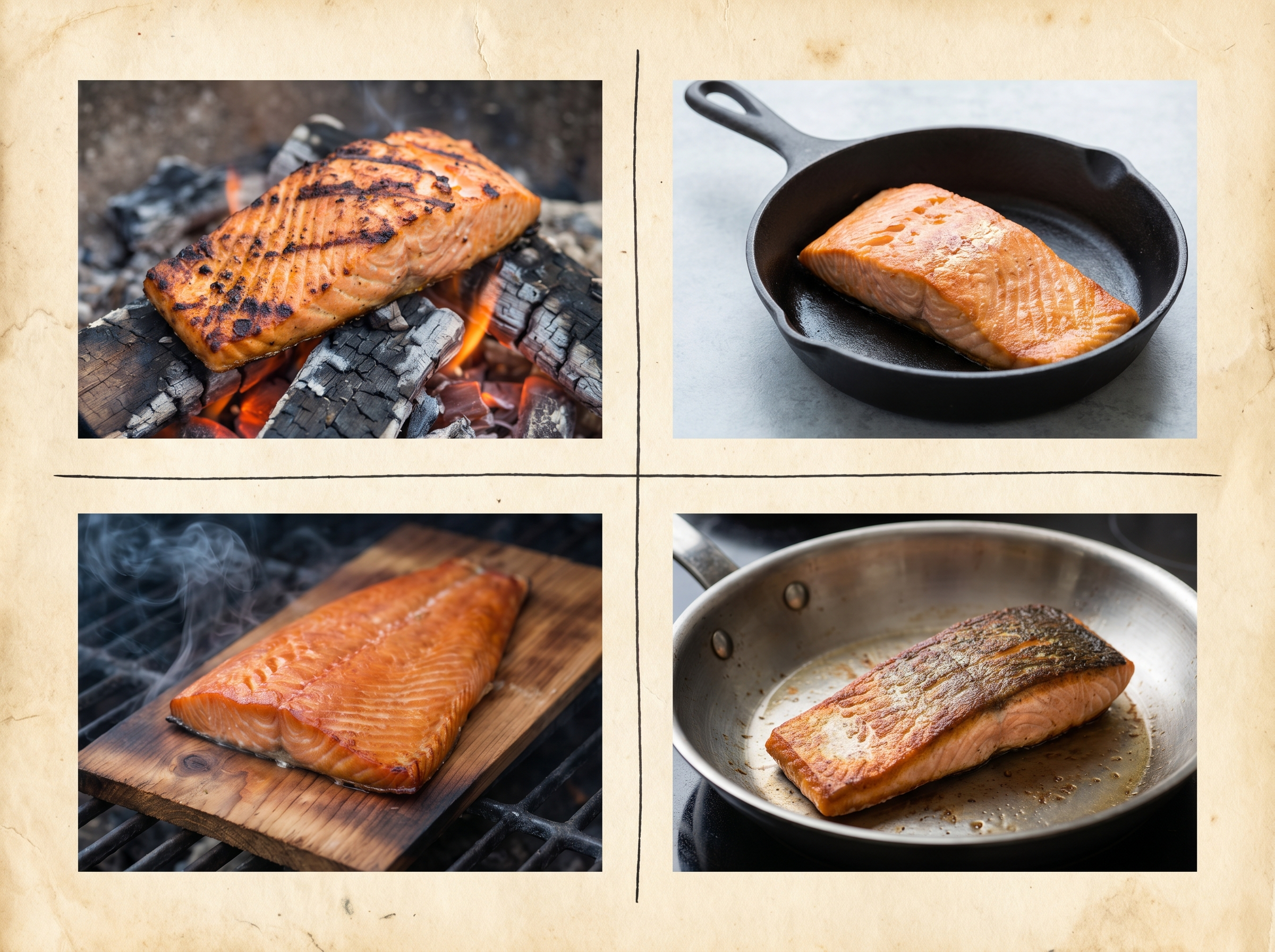
Our wild Alaskan sockeye salmon from Bristol Bay responds beautifully to multiple cooking techniques. Each method highlights different aspects of this premium fish.
Pan-Searing (Restaurant Technique)
Best for: Fillets with skin, achieving crispy exterior while keeping center moist. This is the preferred method in fine dining.
- Remove from fridge: Let salmon sit at room temperature for 10-15 minutes before cooking
- Pat dry thoroughly: Use paper towels to remove all surface moisture from both skin and flesh side
- Season generously: Salt and pepper 2 minutes before cooking—early seasoning draws out moisture, late seasoning prevents this
- Heat pan to medium-high: Use a 10-12 inch stainless steel or cast iron pan. Heat for 2-3 minutes until shimmering
- Add fat: Use 1 tablespoon avocado oil or clarified butter—neutral oils with high smoke points (400°F+)
- Place salmon skin-side down: Gently lay fillet away from you to avoid splashing. Don't move it for 3-4 minutes
- Cook skin side: Maintain medium-high heat. Skin should be crackling and golden, not burning (black=too hot)
- Flip at 3-4 minutes: Insert spatula under skin, lift gently, flip away from you. The flip should be smooth with no sticking
- Cook flesh side: 2-3 minutes until internal temp reaches 140-142°F (60-61°C)
- Rest 3-4 minutes: Transfer to plate. The residual heat continues cooking—carryover cooking of about 2-3°F
Timing for 6 oz fillet: 3-4 minutes skin-side + 2-3 minutes flesh-side + 3-4 minutes rest = 8-11 minutes total.
Oven Baking (Even Results)
Best for: Multiple fillets, hands-off cooking, achieving gentle, consistent results.
- Preheat oven: 400°F (200°C) for 10 minutes
- Prepare sheet pan: Line with parchment paper for easy cleanup
- Arrange salmon: Place skin-side down on parchment, spacing fillets 2 inches apart
- Season: Brush lightly with olive oil, then season with salt and pepper
- Optional aromatics: Add lemon slices, fresh dill, or thin onion slices on top
- Bake: 10-12 minutes until internal temp reaches 140°F (60°C)
- Check doneness: Gently prod with fork—flesh should flake with light pressure
- Rest: 2-3 minutes before serving
Timing for 6 oz fillet at 400°F: 10-12 minutes total.
Grilling (High Heat)
Best for: Summer meals, developing char and smoke flavor, cooking for groups.
- Preheat grill: Medium-high heat (about 400°F), let grates heat for 5 minutes
- Oil grates: Oil a folded paper towel and wipe grates with tongs to prevent sticking
- Prepare salmon: Pat dry, brush very lightly with avocado oil
- Place skin-side up: Lay fillets flesh-side down on grill
- Cook flesh side: 3-4 minutes without moving. Don't flip early—look for grill marks
- Flip once: Turn skin-side down for 2-3 minutes
- Transfer to cool zone: If flare-ups occur, move to cooler part of grill
- Check temp: 140-142°F (60-61°C) in thickest part
Timing for 6 oz fillet: 5-7 minutes total (less time than stovetop).
Air Fryer (Quick & Healthy)
Best for: Weeknight meals, minimal oil, crispy outside with moist inside.
- Preheat: 400°F (200°C) for 3 minutes
- Prepare salmon: Pat dry, brush lightly with avocado oil on flesh side
- Season: Salt, pepper, optional herbs
- Arrange: Place skin-side down in air fryer basket, don't overcrowd
- Cook: 7-9 minutes until 140°F (60°C) internal temp
- Check at 7 minutes: Cooking times vary by air fryer model
Timing for 6 oz fillet at 400°F: 7-9 minutes total.
Poaching (Gentle & Moist)
Best for: Achieving extremely moist texture, making salmon salads, batch cooking.
- Prepare poaching liquid: Use 2 cups water or light fish stock, add 1 tsp salt, 2-3 parsley sprigs, 1 bay leaf, 5-6 peppercorns
- Heat liquid: Bring to gentle simmer (small bubbles, not rolling boil) in skillet large enough for fillets
- Add salmon: Gently slide fillets into simmering liquid
- Maintain temperature: Keep at very gentle simmer, never boiling
- Cook: 8-10 minutes until opaque throughout and flakes with fork
- Remove carefully: Use slotted spatula to lift fillet, drain on paper towel
- Serve warm or cold: Excellent for salads when cooled
Timing for 6 oz fillet: 8-10 minutes total.
Cedar Plank (Aromatic)
Best for: Special occasions, infusing smoky cedar flavor, cooking whole sides of salmon.
- Soak plank: Submerge cedar plank in water for 1-2 hours before cooking
- Preheat grill: Medium-high heat (350-400°F)
- Place plank: On grill grates, close lid for 2 minutes until it starts to smoke
- Arrange salmon: Place fillet skin-side down on plank
- Season: Salt, pepper, optional lemon slices and herbs on top
- Cover grill: Close lid to trap smoke
- Cook: 12-15 minutes for 6 oz fillet until 140°F (60°C)
- Slide onto plate: Use wide spatula, leave fillet on plank for serving
Timing for 6 oz fillet: 12-15 minutes total.
Halibut Cooking Methods
Halibut is leaner and firmer than salmon. It cooks quickly and can dry out easily, so precision with temperature is critical. Our wild-caught Alaskan halibut portions benefit from high heat to develop a golden crust while the interior stays tender.
Pan-Searing (Best Method)
Why this works for halibut: Quick cooking prevents dryness. The crust seals moisture inside.
- Room temperature: Let halibut sit out 15 minutes
- Pat completely dry: Halibut releases more water than salmon—use multiple towels
- Season: Salt and pepper 1-2 minutes before cooking
- Heat pan to high: Use cast iron or stainless steel. Heat 2-3 minutes until very hot
- Add fat: 1.5 tablespoons avocado oil or clarified butter—halibut needs more oil due to its leanness
- Place halibut: Presentation side down first (whichever side will face up when plated)
- Cook 3-4 minutes: Resist moving it. You want a golden, caramelized crust
- Flip once: 2-3 minutes on the other side
- Check temp: 140-142°F (60-61°C) in thickest part—don't exceed 145°F (63°C) or it toughens
- Rest: 2-3 minutes
Timing for 8 oz portion: 5-7 minutes total including rest.
Oven Baking (Predictable)
Best for: Multiple portions, less attention needed, even cooking throughout.
- Preheat oven: 425°F (220°C) for 10 minutes
- Prepare halibut: Pat dry, place on parchment-lined sheet pan
- Brush with oil: Lightly coat with olive oil
- Season: Salt, pepper, fresh herbs if desired
- Bake: 10-12 minutes depending on thickness
- Check at 10 minutes: Insert thermometer into thickest part—should read 138-140°F (59-60°C)
- Rest: 2-3 minutes before serving
Timing for 8 oz portion at 425°F: 10-12 minutes total.
Grilling (Char Crust)
Best for: Developing deep, caramelized exterior, outdoor cooking.
- Preheat grill: High heat (450°F+), let grates very hot
- Oil grates heavily: Halibut sticks more than salmon due to low fat—oil well
- Prepare halibut: Pat very dry, brush lightly with avocado oil
- Place presentation side down: Lay on hot grates
- Cook 3-4 minutes: Look for deep golden marks
- Flip once: 2-3 minutes on reverse side
- Check temp: 138-140°F (59-60°C)—don't rely on visual cues alone
Timing for 8 oz portion: 5-7 minutes total.
En Papillote (Steamed in Parchment)
Best for: Retaining maximum moisture, elegant presentation, adding vegetables and aromatics.
- Preheat oven: 400°F (200°C)
- Cut parchment: Two 12x15 inch pieces per fillet
- Layer ingredients: Place halibut in center, top with: thin lemon slices, fresh dill or tarragon, 2 tablespoons julienned vegetables (carrot, celery)
- Drizzle: 1 teaspoon olive oil, pinch of salt and pepper
- Seal packet: Fold parchment in half, crimp edges tightly starting at one corner
- Bake: 12-14 minutes until parchment puffs (sign of steam inside)
- Open carefully: Hot steam will release—open away from face
- Slide onto plate: Keep parchment partially on plate for presentation
Timing for 8 oz portion: 12-14 minutes total.
Pacific Cod Preparation
Pacific cod is a mild, delicate white fish with a tender flake. It's more delicate than halibut and requires gentle handling to avoid overcooking and drying. Our wild-caught Alaskan Pacific cod cooks quickly due to its lower fat content.
Pan-Frying (Classic Method)
Temperature target: 140°F (60°C) internal—don't exceed 145°F (63°C).
- Prepare: Pat cod completely dry, let sit at room temperature 10 minutes
- Season: Light salt and pepper 1-2 minutes before cooking
- Heat pan: Medium-high heat with 1 tablespoon avocado oil or butter
- Cook: 3-4 minutes per side for 6 oz fillet
- Watch carefully: Cod releases water when done—look for liquid to stop beading on surface
- Check temp: 140°F (60°C) in thickest part
- Rest: 2-3 minutes
Total timing: 6-8 minutes plus rest.
Baking in Parchment
- Preheat oven: 400°F (200°C)
- Prepare packets: Fold parchment to create envelope
- Place cod: Add herbs, lemon, minimal oil
- Bake: 10-12 minutes until opaque throughout
- Open carefully: Steam inside is very hot
Fish Tacos
Pan-fried Pacific cod makes exceptional tacos. Cook fillets using the pan-frying method above, then break into bite-sized pieces. Serve in warm tortillas with: shredded cabbage, fresh cilantro, lime crema (sour cream mixed with lime juice and salt), diced tomatoes, and fresh salsa.
Sablefish Techniques
Sablefish is the most forgiving species due to its high fat content. It's nearly impossible to dry out. Our wild Alaskan sablefish has rich, buttery flesh that tastes remarkable with minimal preparation.
Miso-Glazed (Restaurant Classic)
Temperature: 135-138°F (57-59°C)—sablefish oil stays intact even at lower temps.
- Prepare glaze: Mix 3 tablespoons miso paste, 2 tablespoons mirin (sweet rice wine), 1 tablespoon sake, 1 teaspoon grated ginger
- Marinate: Coat sablefish fillets in glaze, refrigerate 30 minutes to 4 hours
- Preheat oven: 400°F (200°C)
- Pan-sear: Heat oven-safe skillet over medium-high, cook skin-side down 2-3 minutes until skin crisps
- Transfer to oven: Move skillet to oven, bake 6-8 minutes until 135-138°F (57-59°C)
- Finish under broiler: Optional—1-2 minutes under broiler to caramelize glaze
- Garnish: Fresh sesame seeds and scallions
Total timing: 8-12 minutes plus marinating.
Broiling (Quick & Simple)
- Preheat broiler: 5 minutes on high
- Prepare: Place sablefish skin-side down on broiler pan, brush with oil, season lightly
- Position: Place pan 4-5 inches from heat source
- Broil: 8-10 minutes until golden and opaque
- Check temp: 135-140°F (57-60°C)
Total timing: 8-10 minutes.
Pan-Searing (Fat Stays Silky)
- Pat dry: Remove surface moisture
- Heat pan: Medium-high with minimal oil—sablefish renders its own fat
- Cook skin-side down: 4-5 minutes until skin is crispy
- Flip: 2-3 minutes until flesh side is opaque
- Target temp: 135-138°F (57-59°C)
Total timing: 6-8 minutes.
Ground Salmon Recipes
Our ground Alaskan sockeye salmon is versatile for weeknight dinners. Cook ground salmon to 160°F (71°C) internal temperature for food safety.
Salmon Burgers
- Combine: 1 lb ground salmon, 1/3 cup panko breadcrumbs, 1 egg, 1 tablespoon Dijon mustard, zest of 1 lemon, 1/2 teaspoon salt, 1/4 teaspoon pepper
- Mix gently: Don't overmix—this creates dense patties. Mix just until combined
- Form patties: Divide into 4 equal portions, shape into 3/4-inch thick patties
- Chill: Refrigerate 20 minutes to help patties hold together during cooking
- Pan-fry: Heat 1 tablespoon oil in skillet over medium-high heat
- Cook: 3-4 minutes per side until internal temp reaches 160°F (71°C), burgers are opaque throughout
- Toast buns: Optional—butter and toast burger buns in same skillet
- Serve: On buns with lettuce, tomato, avocado, and aioli or tartar sauce
Salmon Meatballs
- Ingredients: 1 lb ground salmon, 1/2 cup panko, 1/4 cup grated Parmesan, 1 egg, 2 tablespoons fresh dill, 1/2 teaspoon garlic powder, salt and pepper
- Combine: Mix ingredients gently
- Form: Roll into 1.5-inch balls (about 16 meatballs)
- Bake option: Place on oiled sheet pan, bake at 400°F (200°C) for 12-14 minutes
- Pan-fry option: Heat oil in skillet, cook meatballs 2-3 minutes per side until browned, finish in oven 5 minutes
- Check temp: 160°F (71°C) in center of largest meatball
- Serve: With tzatziki sauce or tomato sauce
Stir-Fry Crumble
- Heat wok: High heat with 2 tablespoons avocado oil
- Add ground salmon: Break into crumbles with spoon as it cooks, 3-4 minutes
- Add vegetables: 2 cups mixed vegetables (broccoli, bell peppers, snap peas), cook 2-3 minutes
- Make sauce: Mix 3 tablespoons soy sauce, 1 tablespoon rice vinegar, 1 teaspoon sesame oil, 1/2 teaspoon ginger
- Combine: Pour sauce over salmon and vegetables, toss to coat, cook 1 minute
- Serve: Over white or brown rice
Salmon Pasta Sauce
- Sauté aromatics: 2 tablespoons olive oil, 1 diced onion, 3 minced garlic cloves, cook 2 minutes
- Add salmon: 1 lb ground salmon, break into crumbles, cook 3-4 minutes
- Add tomatoes: 28 oz canned crushed tomatoes, 2 tablespoons tomato paste
- Season: 1 teaspoon Italian herbs, salt, pepper, simmer 10 minutes
- Finish: 1/4 cup fresh basil, squeeze of lemon juice
- Serve: Over pasta with fresh Parmesan
Salmon Patties
Convenient, flavorful, and quick—our wild Alaskan seasoned salmon patties are ready to cook. They're pre-formed, pre-seasoned patties made with wild salmon, eggs, and breadcrumbs.
Air Fryer (Quickest)
- Preheat: 380°F (193°C) for 3 minutes
- Place patties: In air fryer basket in single layer, don't overcrowd
- Cook: 8-10 minutes, shaking basket halfway through
- Check doneness: Patties should be golden brown, internal temp 160°F (71°C)
- Total timing: 8-10 minutes
Pan-Frying (Best Crust)
- Heat pan: Medium-high with 1 tablespoon oil (avocado or olive)
- Place patties: Gently lay in hot pan, don't move for 3-4 minutes
- Golden crust: First side should develop golden-brown exterior
- Flip once: 3-4 minutes on second side
- Check temp: 160°F (71°C) in center—use thermometer
- Total timing: 6-8 minutes
Oven Baking (Hands-Off)
- Preheat oven: 400°F (200°C)
- Prepare: Line sheet pan with parchment, arrange patties, brush lightly with oil
- Bake: 12-14 minutes until golden and 160°F (71°C) internally
- Optional step: Flip patties halfway through for even browning
- Total timing: 12-14 minutes
Serving Suggestions
Breakfast: Serve with scrambled eggs, toast, and fresh fruit. Lunch: Top a salad or place in a whole grain roll with tartar sauce and lettuce. Dinner: Pair with roasted vegetables and brown rice. Quick meals: Serve with sweet potato and steamed broccoli.
Seasonings & Flavor Pairings
Wild Alaskan fish, like our Bristol Bay sockeye, has a clean, pure flavor that shines with thoughtful seasoning. The key is letting the fish quality speak first.
Simple Preparations (Let the Fish Shine)
The classic approach: Coarse sea salt, freshly cracked black pepper, fresh lemon juice. This is the restaurant standard because it highlights the fish's natural flavor. For a 6 oz salmon fillet: 1/4 teaspoon sea salt, pinch of pepper, squeeze of fresh lemon after cooking.
Asian-Inspired Pairings
Best for: Salmon, sablefish. Flavors: Soy sauce, ginger, sesame oil, sake, miso, wasabi. Example: Brush salmon with mixture of 2 tablespoons soy sauce, 1 tablespoon mirin, 1 teaspoon grated ginger before pan-searing. Top with sesame seeds and thin scallions after cooking.
Mediterranean Pairings
Best for: All species. Flavors: Olive oil, lemon, fresh herbs (dill, parsley, basil), garlic, capers, olives. Example: Brush halibut with olive oil mixed with minced garlic and fresh dill. Top with lemon slices and fresh herbs before baking.
Pacific Northwest Pairings
Best for: Salmon, sablefish. Flavors: Cedar, mushrooms, berries, hazelnuts, wild greens. Example: Pan-sear salmon, top with sautéed mushrooms, fresh blackberries, and a drizzle of hazelnut oil. Finish with fresh chervil.
Spicy & Southwest Pairings
Best for: Salmon, cod. Flavors: Cumin, chili powder, lime, cilantro, jalapeño. Example: Rub salmon with cumin, smoked paprika, and light chili powder before cooking. Serve with cilantro-lime crema and fresh pico de gallo.
Species-Specific Pairing Guide
| Species | Flavor Profile | Best Pairings |
|---|---|---|
| Sockeye Salmon | Rich, full-bodied, slightly sweet | Dill, lemon, soy, miso, cedar smoke, mushrooms, asparagus |
| Halibut | Mild, delicate, lean | Lemon, butter, capers, fresh herbs, garlic, olive oil |
| Pacific Cod | Subtle, gentle, flaky | Light lemon, fresh herbs, capers, white wine, tomato |
| Sablefish | Rich, buttery, bold | Miso, soy, ginger, sesame, stronger spices, brown butter |
| Ground Salmon | Mild, versatile, slightly sweet | Dill, lemon, garlic, ginger, cumin, cilantro, Mediterranean herbs |
Common Cooking Mistakes & How to Avoid Them
Mistake #1: Overcooking (The #1 Problem)
This is the most common mistake and the easiest to fix. Overcooked fish becomes dry, tough, and loses flavor. Wild salmon at 150°F (65°C) tastes completely different—and worse—than at 140°F (60°C).
Mistake #2: Not Bringing Fish to Room Temperature
Cold fish from the refrigerator won't cook evenly. The outside cooks before the inside is defrosted, leading to overcooked exterior and under-cooked interior.
The fix: Remove fish from refrigerator 15 minutes before cooking. This is especially important for pan-searing and grilling.
Mistake #3: Cooking Frozen Fish Incorrectly
You can cook frozen fish directly, but many people use too much heat. This cooks the outside before the center thaws, resulting in dry edges.
The fix: If cooking from frozen, use lower heat and longer cooking time. A 6 oz frozen salmon fillet in a 350°F (175°C) oven takes 15-18 minutes instead of 10-12 minutes when thawed. Or thaw properly first (see Part 1).
Mistake #4: Pan Temperature Too Low
If your pan isn't hot enough, fish releases water and steams instead of searing. This prevents the golden crust that seals in juices.
The fix: Heat your pan for 2-3 minutes over medium-high heat until it's very hot. Oil should shimmer and move easily. If oil sits still, the pan isn't ready.
Mistake #5: Moving Fish Too Early
Constant poking and flipping tears delicate fish and prevents proper browning. Many home cooks flip their fish 3-4 times instead of once.
The fix: Place fish in the pan and leave it alone for 3-4 minutes. Flip exactly once and cook the other side. Resist the urge to move it.
Mistake #6: Under-Seasoning
Premium wild fish deserves proper seasoning. Many people use too little salt, which makes the fish taste bland no matter how perfect the cooking.
The fix: Use 1/4 teaspoon sea salt per 6 oz fillet. Taste and adjust. You should taste salt clearly—it enhances the fish's natural flavor, not overpowers it.
Mistake #7: Ignoring Residual (Carryover) Cooking
Fish continues to cook after you remove it from heat. Remove at 142°F (61°C) and it will be 145°F (63°C) after resting.
The fix: Always rest fish for 3-4 minutes. Remove from heat source 2-3°F before target temperature and let carryover cooking do the work.
Essential Equipment Guide
Must-Haves
- Instant-read thermometer: Digital is best, 3-second readout. Brands: Thermapen, ThermoPop, Lavatools. Price: $25-80. This single tool prevents overcooking 90% of the time.
- 10-12 inch skillet: Stainless steel or cast iron. Avoid non-stick for high-heat searing—they have low smoke points. A good skillet costs $30-80 and lasts decades.
- Fish spatula: Thin, flexible blade designed for delicate fish. Much better than a regular spatula. Price: $10-25.
- Sharp knife: 6-8 inch chef's knife for portioning and filleting. A dull knife tears fish. Price: $25-100.
- Paper towels: For patting fish dry. This step prevents moisture loss during cooking and is essential.
Nice-to-Haves
- Cast iron skillet: Excellent for searing. Retains heat beautifully. Requires seasoning but lasts a lifetime. Price: $15-40.
- Oven-safe skillet: Allows you to start on stovetop and finish in oven. Saves time. Price: $30-80.
- Grill brush: Keeps grill grates clean and prevents sticking. Price: $10-20.
- Cedar planks: For plank grilling. Must be soaked before use. Price: $5-10 per pair.
- Parchment paper: For baking and steaming. Makes cleanup easy. Price: $5-10.
- Spray bottle: For oil—less than brush application. Price: $3-8.
FAQ (10 Questions)
Frequently Asked Questions
1. How do I know when fish is done without a thermometer?
Visual cues: Cooked salmon should be opaque throughout with a slight line of white albumin visible. If you gently prod with a fork, it should flake into chunks. The opacity changes from translucent pink to opaque white. For halibut, look for complete opaqueness throughout. For cod, the flesh should separate easily from the bone if cooking whole fish. Use visual cues as a backup; a thermometer is the most reliable check.
2. Can I cook salmon from frozen?
Yes, but thaw first if possible. Frozen fish requires 30-50% longer cooking time. A frozen 6 oz salmon fillet in a 350°F (175°C) oven takes 15-18 minutes instead of 10-12 minutes. For best results, use cold water thawing (30-60 minutes) before cooking. This prevents dry edges that result from cooking frozen fish at high heat.
3. What's the best oil for cooking fish?
Avocado oil or clarified butter. Both have smoke points above 400°F (200°C). Avocado oil is neutral-tasting and works for all methods. Clarified butter adds richness, especially for halibut. Avoid extra-virgin olive oil for high-heat searing (smoke point 190°F/87°C). Virgin olive oil is fine (420°F/215°C). Never use coconut oil—it masks the fish's delicate flavor.
4. Why does my fish stick to the pan?
Three reasons: 1) Pan isn't hot enough—oil should shimmer, 2) Fish is too wet—pat it completely dry, 3) You're moving it too early—wait 3-4 minutes before flipping. A properly heated pan with dry fish won't stick. If it does stick, let it cook longer—it will release naturally when the crust forms.
5. How do I get crispy skin on salmon?
Four steps: 1) Pat skin completely dry with paper towels, 2) Place skin-side down in a cold pan, 3) Turn heat to medium, then medium-high, 4) Don't move the fillet—let it cook 3-4 minutes until skin releases from pan naturally. The gradual heat rendering allows skin to crisp. Don't flip until skin is golden brown.
6. Is it safe to eat salmon medium-rare?
It’s a texture choice, not a safety standard. The FDA recommends cooking seafood to 145°F (63°C). Many chefs serve salmon at 140-142°F (60-61°C), with a slightly translucent center, because it stays moister. Freezing controls parasites, not bacteria, so the FDA advises pregnant women, young children, older adults and anyone with a weakened immune system to eat seafood cooked to 145°F (63°C).
7. How long does cooked fish last in the refrigerator?
3-4 days maximum. Store in an airtight container on the coldest shelf of your refrigerator. Cooked fish degrades quickly—the proteins begin breaking down. Use sooner rather than later for best quality. If you won't eat it within 2-3 days, freeze it for up to 3 months.
8. What sides pair well with fish?
Light options: Steamed or roasted vegetables (asparagus, broccoli, green beans), roasted root vegetables, fresh salads with vinaigrette. Starchy options: Brown rice, wild rice, quinoa, roasted potatoes, pasta with light sauce. Sauce options: Lemon beurre blanc, dill cream sauce, salsa verde, tartar sauce. Avoid heavy, rich sides that compete with the delicate fish flavor.
9. Can I reheat cooked fish?
Yes, but carefully. Gentle reheating preserves texture. Options: 1) Oven method—wrap in foil, heat at 275°F (135°C) for 10-15 minutes, 2) Steamer—place on parchment over simmering water for 3-5 minutes, 3) Microwave—use low power (30-50%) in short bursts (30-45 seconds), checking every 15 seconds. Never high heat—this dries it out. Reheat until it is hot all the way through (USDA advises reheating leftovers to 165°F). Best option: eat fish fresh from cooking.
10. How do I prevent the white albumin from leaking out?
You can't prevent it entirely—it's natural. When proteins denature, albumin (coagulated egg white-like substance) forms and sometimes leaks out. This is normal and doesn't mean the fish is overcooked. To minimize it: 1) Don't puncture the fish with knife or fork before cooking, 2) Avoid rapid temperature swings, 3) Remove from heat slightly before target temperature. The albumin is harmless and many chefs regard it as a sign of perfect cooking at 60-65°C (140-149°F).
Ready to Cook?
Get Premium Wild Alaskan Seafood
Every technique in this guide shines with our wild Alaskan fish: sockeye from our family's Bristol Bay setnets, and halibut, Pacific cod and sablefish caught by other Alaska fishermen. No farm-raised substitutes, no compromise on quality.
Recipe Inspiration
Now that you've mastered the techniques, explore our recipe collection for specific dish ideas using wild Alaskan salmon, halibut, cod, and sablefish. From simple weeknight meals to dinner party showstoppers, we have recipes for every skill level and occasion. You can also browse our complete recipes hub organized by species, cooking method, and meal type for faster browsing. If you want to make the most of your seafood budget, our wild seafood budget guide covers meal planning strategies, bulk buying tips, and value-stretching recipes.