
Wild Caught
Wild-Caught vs. Farm-Raised Salmon: The Complete Guide
Color, fat, contaminants, taste. Side by side, the differences are bigger than the marketing suggests.
Key Takeaways
- Farmed salmon has more total omega-3; wild sockeye is leaner, with a better omega-3 to omega-6 ratio — about 1,800 mg vs. 730 mg EPA + DHA per 3 oz cooked serving (USDA), because farmed salmon is much fattier, but roughly 4:1 omega-3 to omega-6 in sockeye versus about 2.5:1 in farmed Atlantic, largely due to plant-based feed oils used in aquaculture.
- Farmed salmon has tested significantly higher in PCBs and dioxins — a 2004 study in Science (Hites et al.) found organochlorine contaminants “significantly higher in farmed salmon than in wild,” with European-raised salmon highest. Farm feeds have changed since that testing.
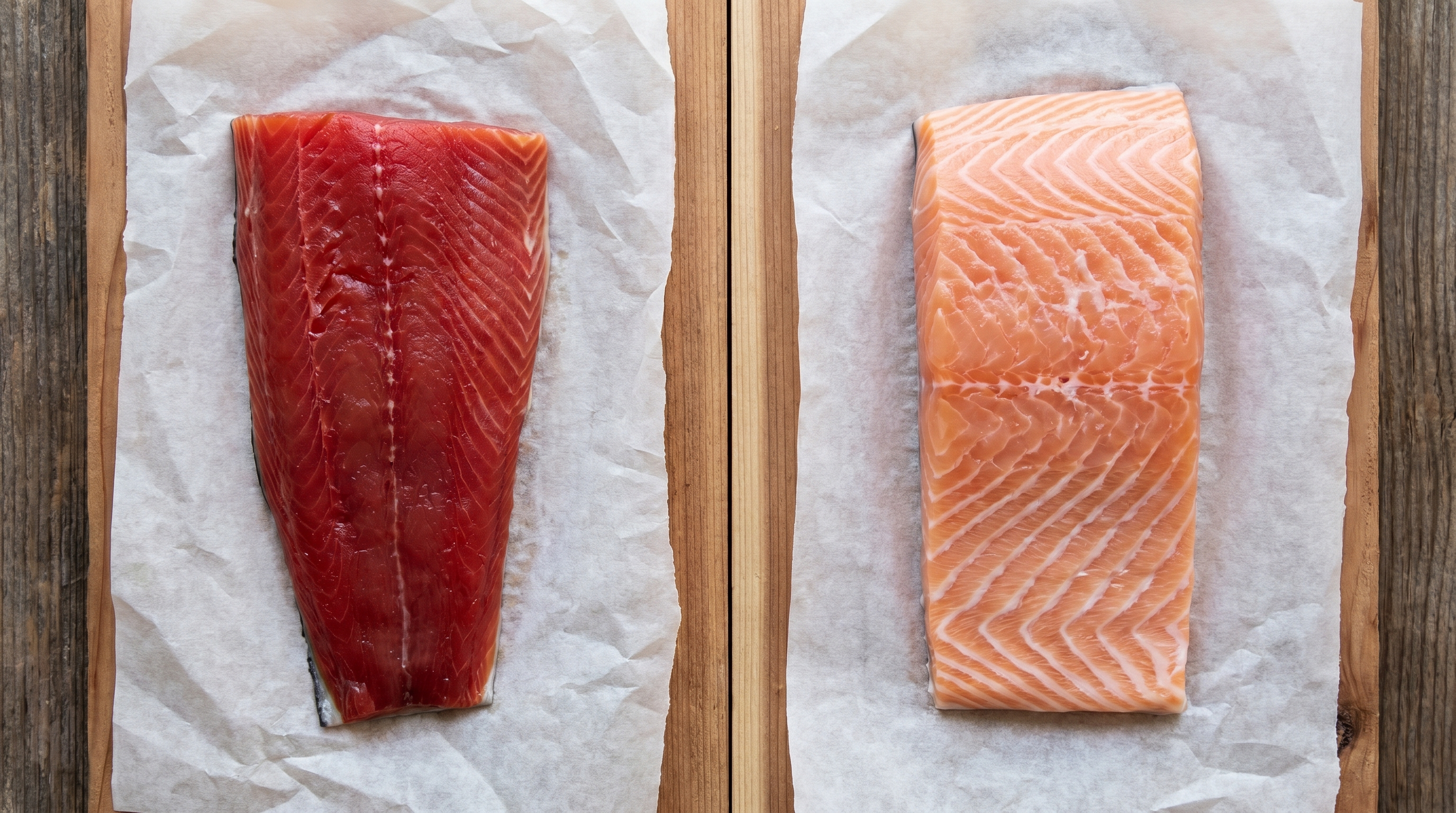
- Wild salmon gets its color naturally from astaxanthin in its diet — farmed salmon gets its color from astaxanthin or canthaxanthin added to its feed pellets.
- Don’t judge by the name alone — most Atlantic salmon in stores is farmed, so check the label for the words “wild” or “farm-raised,” the species and the country of origin. Alaska’s ban on salmon farming covers Alaska, not the whole U.S.
- Flash-frozen wild salmon is often fresher than “fresh” farmed — frozen within hours of harvest, it locks in peak quality that days of transport cannot match.
- Salmon is a low-mercury fish regardless of source — fresh and frozen salmon average 0.022 ppm in FDA testing, and FDA and EPA list salmon as a “Best Choice” (2–3 servings a week).
In This Guide
1. Why Does the Wild vs. Farmed Distinction Matter?
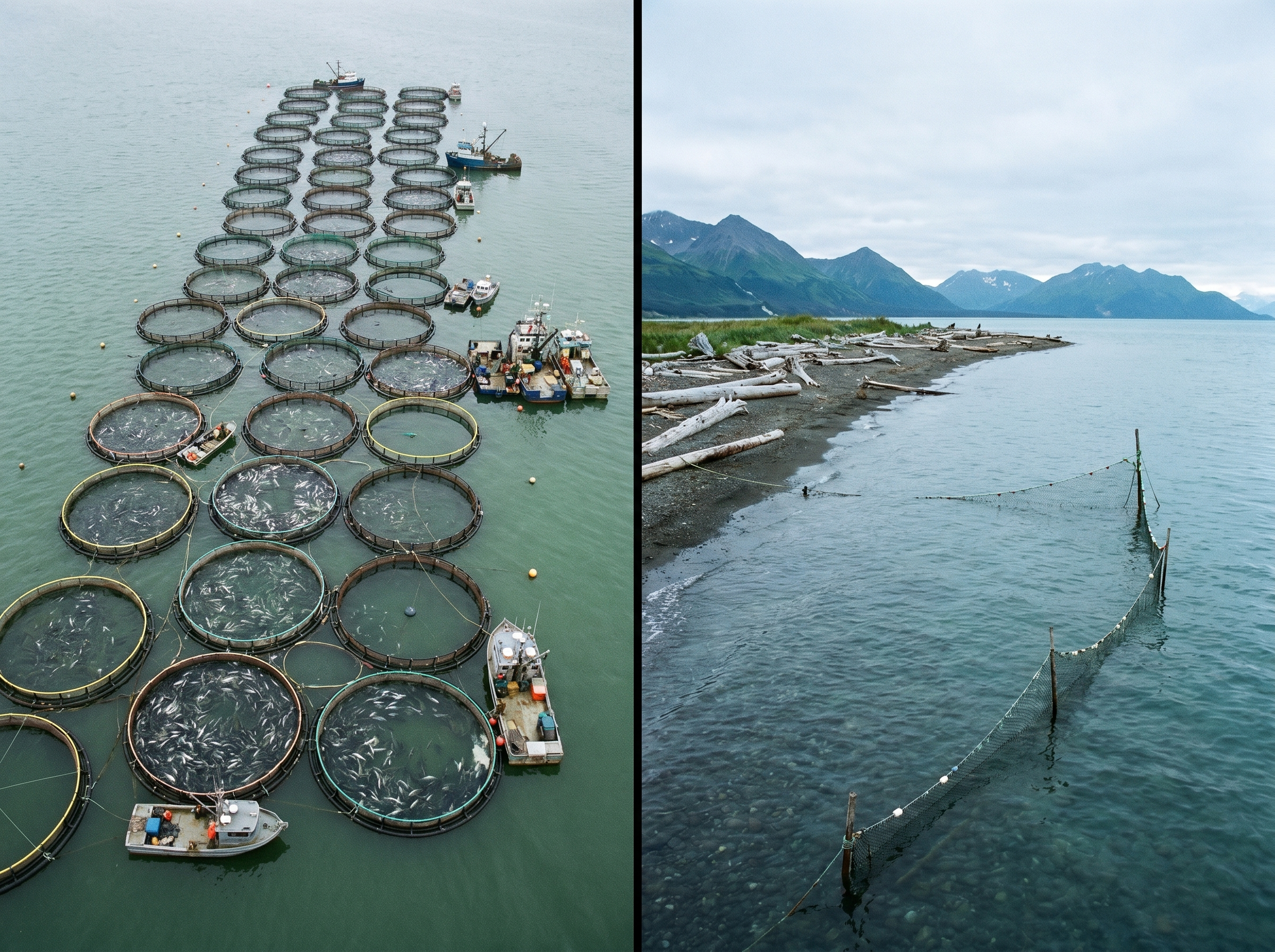
Salmon is one of the most consumed fish in the United States — Americans eat roughly 2.5 pounds per capita annually. But not all salmon is created equal. The fish labeled “salmon” at your grocery store can come from two radically different systems: wild fisheries in the open ocean, or farm operations that raise fish in crowded net pens. The differences between these two sources affect everything from nutritional value and contaminant levels to environmental sustainability and flavor.
Today, approximately 70% of the salmon consumed worldwide is farmed, primarily Atlantic salmon (Salmo salar) raised in net pens in Norway, Chile, Scotland, and Canada. The remaining 30% is wild-caught — overwhelmingly Pacific species like king (Chinook), sockeye, coho, pink, and chum, harvested from Alaskan, Russian, and Pacific Northwest fisheries.
For health-conscious consumers, the question is straightforward: which salmon is better for my body, my family, and the planet? This guide answers that question with data from the EPA, FDA, USDA, and peer-reviewed research — not marketing claims.
What Are We Actually Comparing?
Wild-Caught Salmon
Born in freshwater rivers, migrates to the open ocean, feeds on a natural diet of krill, shrimp, herring, and squid. Harvested by commercial fishermen during seasonal runs. Five Pacific species: king (Chinook), sockeye (red), coho (silver), pink, and chum (keta).
Diet: Krill, shrimp, squid, herring
Lifespan: 2–7 years in the wild
Habitat: Open North Pacific Ocean
Farm-Raised Salmon
Hatched in freshwater hatcheries, transferred to ocean net pens (floating cages) at 12–18 months. Fed manufactured pellets of fishmeal, fish oil, plant proteins (soy, corn), vitamins, and added color pigments. Almost exclusively Atlantic salmon.
Diet: Processed feed pellets
Lifespan: 2–3 years in pens
Habitat: Crowded ocean net pens
A Note on Objectivity
Popsie Fish Co is a wild Alaskan salmon company — we have an obvious perspective here. That said, every claim in this guide is sourced from peer-reviewed research, government data, or established scientific organizations. Where the data is nuanced, we say so. Where it overwhelmingly favors wild salmon, we let the numbers speak.
2. Wild vs. Farmed Salmon at a Glance
Before diving into the details, here is a high-level comparison across the factors that matter most. Each of these topics is explored in depth in the sections that follow.
| Factor | Wild-Caught | Farm-Raised |
|---|---|---|
| Omega-3s (EPA+DHA per 3 oz cooked) | ~520–1,500 mg (sockeye ~730) | ~1,800 mg* |
| Omega-3 to Omega-6 Ratio | ~4:1 (sockeye) | ~2.5:1 |
| Total Fat | 4.7 g per 3 oz cooked (sockeye) | 10.5 g per 3 oz cooked |
| Calories (3 oz cooked) | 133 (sockeye) | 175 |
| PCB Levels (Hites 2004) | Lower | Significantly higher |
| Antibiotic Use | None | Common (varies by country) |
| Color Source | Natural astaxanthin from diet | Astaxanthin / canthaxanthin added to feed |
| Protein (3 oz cooked) | 22.5 g (sockeye) | 18.8 g |
| Vitamin D | ~570 IU (71% DV) per 3 oz cooked (sockeye) | ~450 IU (56% DV) per 3 oz cooked |
| Astaxanthin | Natural (from krill and other prey) | Added to feed (amount varies) |
| Mercury | Very low (~0.022 ppm) | Very low (~0.022 ppm) |
| Environmental Impact | Sustainably managed fisheries | Sea lice, escapees, waste, antibiotics |
| Flavor Profile | Complex, clean, species-specific | Mild, uniform, fattier |
| Price per Pound | $12–30+ (varies by species) | $6–12 |
*Farmed Atlantic salmon has more total omega-3 than wild sockeye because it is much fattier, but its omega-3:omega-6 ratio is worse. Nutrient values are per 3 oz cooked serving from USDA FoodData Central (the wild omega-3 range runs from pink to king salmon); ratios are approximate, computed from USDA fatty-acid data. Mercury is FDA’s average for fresh and frozen salmon, which does not separate wild from farmed. PCB comparison from Hites et al. (Science, 2004).
The key takeaway from this table: Farmed salmon beats wild sockeye on total omega-3 quantity (thanks to being fattier overall), but it falls behind on calories and fat, contaminant levels in the 2004 Hites testing, omega-3:omega-6 ratio, vitamin D, color source, environmental impact, and flavor complexity. Its other clear advantage is price.
Quick Stats: The Wild Advantage by the Numbers
3. How Does the Nutrition of Wild Salmon Compare to Farmed?
Both wild and farmed salmon are nutritious foods — that is not in dispute. They are both excellent sources of protein, B vitamins, and selenium, and both supply EPA and DHA omega-3s. The differences, however, are significant when you look past the marketing and into the actual nutrient profiles.
Macronutrient Comparison (per 3 oz / 85g Cooked Serving)
| Nutrient | Wild Sockeye | Wild King | Farmed Atlantic |
|---|---|---|---|
| Calories | 133 | 196 | 175 |
| Protein | 22.5 g | 21.8 g | 18.8 g |
| Total Fat | 4.7 g | 11.4 g | 10.5 g |
| Omega-3s (EPA+DHA) | ~730 mg | ~1,500 mg | ~1,800 mg |
| Omega-3:6 Ratio | ~4:1 | ~7:1 | ~2.5:1 (raw) |
| Saturated Fat | 0.8 g | 2.7 g | 2.0 g |
| Cholesterol | 52 mg | 72 mg | — |
Micronutrient Comparison
| Nutrient | Wild Sockeye | Wild King | Farmed Atlantic |
|---|---|---|---|
| Vitamin D | ~570 IU (71% DV) | No USDA value | ~450 IU (56% DV) |
| Vitamin B12 | 3.8 mcg (158% DV) | 2.4 mcg (100% DV) | — |
| Selenium | 30 mcg (55% DV) | 40 mcg (72% DV) | — |
| Astaxanthin | Natural | Natural | Added to feed (varies) |
| Potassium | 371 mg | 429 mg | — |
Per 3 oz (85 g) cooked serving, from USDA FoodData Central; USDA lists no vitamin D value for king salmon, and a dash marks a value not shown here. Omega-3:6 ratios are approximate, computed from USDA fatty-acid data (the farmed figure uses USDA’s raw row because its cooked row has a data problem). Exact amounts vary by individual fish, season, and preparation method.
Nutrition Verdict
Wild sockeye delivers more protein per calorie, more vitamin D (about 570 vs. 450 IU per 3 oz cooked), a better omega-3:omega-6 ratio, and natural astaxanthin. Farmed Atlantic has more total omega-3 (about 1,800 mg vs. 730 mg EPA + DHA per 3 oz cooked) because it is fattier, and with that it carries more calories, more total and saturated fat, and more omega-6s. If you want a leaner fish with a better fatty-acid balance, wild sockeye is the stronger choice.
4. What Contaminants Are in Farmed vs. Wild Salmon?
Contaminants are one of the most discussed differences between wild and farmed salmon. The best-known comparison is a 2004 study, and farm feeds have changed since, so read its results as a dated comparison.
PCBs (Polychlorinated Biphenyls)
PCBs are industrial chemicals banned in the 1970s that persist in the environment and accumulate in the food chain. They are classified as probable human carcinogens by the EPA. A landmark 2004 study published in Science by Hites et al. analyzed over 2 metric tons of farmed and wild salmon from around the world and found organochlorine contaminant concentrations, including PCBs, “significantly higher in farmed salmon than in wild,” with European-raised salmon highest.
Those are 2004 results from older farm feeds. Feeds have changed since: a later study of Scottish farmed salmon found EPA and DHA levels fell between 2006 and 2015 as plant ingredients replaced fish oil (Sprague et al., 2016). Treat the Hites findings as a dated comparison, not a measurement of today’s farmed salmon.
Dioxins and Dioxin-like Compounds
The same Hites et al. study found that farmed salmon contained significantly higher levels of dioxins, dieldrin, and toxaphene compared to wild. Dioxins are among the most toxic synthetic chemicals known, and they accumulate in fatty tissues, one reason the fattier farmed salmon in that 2004 testing carried more.
Antibiotics and Pesticides
Wild salmon requires zero antibiotics — there is no mechanism to administer them to fish in the open ocean, and no need, because wild fish are not concentrated in dense populations where disease spreads rapidly. Farmed salmon is a different story:
- Antibiotics: Used prophylactically and therapeutically in many farming operations. Chilean salmon farms have historically been the heaviest users. This contributes to antibiotic-resistant bacteria.
- Pesticides: Chemical treatments like emamectin benzoate and hydrogen peroxide are used to control sea lice infestations in farm pens. Residues can persist in the fish flesh.
- Fungicides: Used in hatchery stages to prevent egg mortality from fungal infection.
- Growth hormones: Not currently approved for salmon in most markets, though growth-accelerated (AquAdvantage) GMO salmon has been approved in both the U.S. and Canada.
FDA vs. EPA safety thresholds: The FDA’s tolerance for PCBs in fish is 2 ppm (2,000 ppb) — a threshold so high that virtually no commercial fish exceeds it. The EPA, however, sets cancer-risk based consumption guidelines at dramatically lower levels.
Heavy Metals
Mercury levels in salmon are consistently low: fresh and frozen salmon average 0.022 ppm in FDA testing (FDA’s table does not separate wild from farmed), well within the FDA’s “Best Choices” category. Salmon, regardless of source, is one of the lowest-mercury fish available. This is one area where wild and farmed salmon are comparable. Other heavy metals (arsenic, cadmium, lead) are generally low in both, though some studies have found slightly higher arsenic in farmed salmon linked to feed composition.
Contaminant Verdict
In the 2004 Hites study, wild salmon had significantly lower levels of PCBs, dioxins, and organochlorine pesticides than farmed salmon. Both are low in mercury. Wild salmon has zero exposure to antibiotics. Farm feeds have changed since 2004, so that study can’t tell you how today’s farmed salmon compares.
5. Why Does the Omega-3 to Omega-6 Ratio Matter?
Raw omega-3 content is the number the salmon industry likes to highlight. And by that measure, farmed salmon comes out ahead: because it is much fattier, USDA lists about 1,800 mg EPA + DHA per 3 oz cooked serving of farmed Atlantic versus about 730 mg for wild sockeye. But this tells only half the story. The ratio of omega-3 to omega-6 fatty acids is what nutrition researchers increasingly focus on — and it is where wild and farmed salmon differ.
Understanding the Ratio
Omega-3 and omega-6 fatty acids compete for the same metabolic pathways in your body. Omega-3s (EPA, DHA) are anti-inflammatory. Omega-6s (primarily linoleic acid) promote inflammation when consumed in excess.
How the Ratio Compares
Omega-3 to Omega-6 Ratio (higher is better; approximate, computed from USDA data)
Why Is Farmed Salmon’s Ratio Worse?
The answer is simple: feed composition. Wild salmon eat krill, shrimp, and small fish — all rich in omega-3s and very low in omega-6s. Farmed salmon eat manufactured pellets that increasingly substitute soy oil, canola oil, and corn gluten for expensive fish oil. These plant-based oils are loaded with omega-6 linoleic acid. As aquaculture has scaled, the percentage of plant ingredients in feed has risen from roughly 20% in the 1990s to over 50% today — and the omega-3:omega-6 ratio of farmed salmon has worsened accordingly.
The trend is getting worse, not better. As global demand for fish oil outstrips supply, salmon farmers continue to replace marine-based oils with cheaper plant-based alternatives. A study of more than 3,000 Scottish farmed Atlantic salmon (Sprague et al., Scientific Reports, 2016) found that EPA and DHA levels fell between 2006 and 2015 as feeds replaced fish oil with plant ingredients — though the authors note farmed salmon still delivers more EPA and DHA than most other fish.
When you eat salmon for the omega-3 health benefits, the goal is to shift your overall omega-3:omega-6 balance toward a healthier ratio. Wild salmon accomplishes this efficiently because it delivers a large amount of omega-3 with very little omega-6. Farmed salmon delivers omega-3 but simultaneously adds a significant load of omega-6 that partially offsets the benefit.
Omega Ratio Verdict
Wild sockeye’s omega-3:omega-6 ratio is roughly 4:1, versus about 2.5:1 for farmed Atlantic salmon (computed from USDA data). Farmed salmon delivers more total omega-3 per serving, but more omega-6 comes with it. If your goal is a better fatty-acid balance, wild sockeye is the better fit.
6. Natural vs. Synthetic Astaxanthin: Why the Color Tells a Story
The vibrant pink-orange color of salmon flesh comes from astaxanthin, a carotenoid pigment and one of the most powerful antioxidants found in nature. But how that color gets into the flesh differs dramatically between wild and farmed fish.
How Wild Salmon Gets Its Color
Wild salmon accumulate natural astaxanthin by eating their way up the food chain. Microalgae produce it. Krill and shrimp eat the algae. Salmon eat the krill and shrimp. Over the course of 2–7 years in the open ocean, wild salmon build up significant concentrations of this antioxidant in their flesh. The result is the deep red of sockeye, the rich orange of king, and the medium pink of coho — each color reflecting the fish’s natural diet and species.
How Farmed Salmon Gets Its Color
Without astaxanthin supplementation, farmed salmon flesh is naturally gray. Consumers would not buy it. So salmon farmers add astaxanthin or canthaxanthin to feed pellets. Farmers select the exact shade of pink-orange using a tool called the SalmoFan (developed by DSM, a chemical company), which works like a paint chip fan. The most commonly selected shades fall between DSM color numbers 24 and 28.
What is the SalmoFan? A proprietary color fan made by DSM (formerly Roche/Hoffman-La Roche) that lets salmon farmers dial in the exact flesh color they want. The color additive (astaxanthin or canthaxanthin) is then dosed into feed pellets at the precise concentration needed to achieve that shade. Color additives can represent up to 20% of the total feed cost in farmed salmon production.
Does It Matter Nutritionally?
Research suggests it may. Natural astaxanthin from microalgae (the form wild salmon accumulate) has demonstrated significantly stronger antioxidant activity in studies compared to synthetic versions. Natural astaxanthin is predominantly in the esterified form, which some research suggests has better bioavailability and stability.
Sockeye’s deep red flesh comes from the astaxanthin it gets from krill and other prey; farmed salmon get astaxanthin added to their feed. The amount and bioavailability of the astaxanthin added to farmed salmon is less consistent and less well-studied.
7. What Is the Environmental Impact of Salmon Farming vs. Wild Fisheries?
Environmental sustainability is a major factor for many consumers. The salmon farming industry markets itself as a solution to overfishing, but the reality is more complex — and in several important ways, the opposite of what the marketing suggests.
Open-Net Pen Farming: The Problems
Sea Lice
Crowded net pens are breeding grounds for parasitic sea lice (Lepeophtheirus salmonis). These parasites spread to wild juvenile salmon and sea trout passing near farms, often with lethal results. Studies in British Columbia, Norway, and Ireland have documented significant wild salmon smolt mortality attributable to sea lice from nearby farms. In some BC rivers, sea lice from farms have been linked to 80%+ mortality in migrating wild pink salmon juveniles.
Disease Transfer
Dense populations of farmed salmon amplify diseases that spread to wild stocks. Infectious Salmon Anemia (ISA), Piscine Orthoreovirus (PRV), and bacterial kidney disease are among the pathogens documented in net-pen operations. Farm-origin pathogens have been detected in wild salmon populations in British Columbia, Norway, Scotland, and Chile. The 2007 ISA crisis in Chile destroyed the country’s salmon farming industry for several years.
Escapees & Genetic Contamination
Farm salmon regularly escape from net pens. In Norway alone, documented escapees exceed 150,000–200,000 fish per year. Escaped farmed Atlantic salmon interbreed with wild populations, introducing maladapted genetics that reduce survival fitness. Studies in Norway and Ireland have found that hybrid offspring have lower survival rates in the wild, gradually weakening native gene pools.
Waste & Pollution
A single large salmon farm can produce waste equivalent to a city of 20,000 people. Uneaten feed, feces, and chemical treatments (antibiotics, pesticides) flow directly into the surrounding marine environment through the open-net pen structure. This nutrient loading can cause algal blooms, oxygen depletion, and degradation of the seafloor beneath and around farm sites.
The Feed Conversion Problem
Farmed salmon are carnivores raised on pellets that contain significant amounts of wild-caught forage fish (anchovies, sardines, herring) ground into fishmeal and fish oil. While the industry has improved feed conversion ratios over time, it still takes roughly 1.2–1.5 pounds of wild-caught fish to produce 1 pound of farmed salmon (when accounting for fish oil and fishmeal inputs). This means salmon farming is a net consumer of ocean protein, not a producer of it. The forage fish used in feed comes from fisheries in South America, West Africa, and the North Sea, some of which face their own sustainability challenges.
How Wild Alaskan Fisheries Compare
- Zero antibiotics, zero pesticides, zero feed inputs — wild salmon feed themselves on the ocean’s natural food web. No external inputs are required.
- Constitutional protection: Alaska’s state constitution mandates sustained-yield management of all fish and wildlife. Sustainability is the law, not a voluntary commitment.
- Real-time management: Alaska Department of Fish & Game monitors every major salmon run using sonar counters, aerial surveys, and test fisheries. Fishing is opened or closed in real-time based on actual fish counts, not predictions.
- Escapement-first policy: Enough spawners must pass upstream to meet biological escapement goals before any commercial fishing opens. If runs are weak, fishing is restricted or shut down entirely.
- No hatchery dependence: Bristol Bay salmon are entirely wild — born in rivers, reared in the ocean, managed as wild stocks. No hatchery supplementation props up the runs.
- Pristine habitat: Bristol Bay has no dams, no industrial development, and no mines on its headwaters. The rivers that produce these fish flow through undisturbed wilderness.
Carbon Footprint
Life-cycle assessments of salmon production show mixed results depending on methodology. Wild salmon from Alaska involves significant fuel use in fishing vessels and air freight to markets in the Lower 48 and internationally. Farmed salmon operations use energy for feed production, feed transport, farm operations, and product transport. Studies that include the full supply chain — including the footprint of catching and processing forage fish for feed — generally find that the carbon advantage of either system is small, and depends heavily on the specific fishery or farm being analyzed and the distance to market.
Where wild salmon has a clear environmental advantage is in ecosystem impact: no waste discharge, no disease amplification, no chemical treatments, no risk of genetic contamination, and no dependence on wild forage fish for feed.
Environmental Verdict
Wild Alaskan salmon from sustainably managed fisheries is the environmentally superior choice. Open-net pen salmon farming creates documented harms to marine ecosystems, including sea lice transmission, disease spread, genetic contamination, and ocean pollution. The carbon footprints are roughly comparable, but the broader ecological impacts are not.
8. How Do Wild and Farmed Salmon Taste Different?
Flavor is subjective, but the differences between wild and farmed salmon are distinct enough that most people notice them immediately in a side-by-side comparison. The distinction comes down to diet, fat composition, and how the fish lived its life.
Wild Salmon Flavor Profile
Flavor: Clean, complex, and species-specific. Wild sockeye is bold and almost meaty. Wild king is rich, buttery, and deeply savory. Wild coho is mild and delicate with a clean finish. Each species has its own character.
Texture: Leaner and firmer than farmed. The flesh is denser with more defined flake structure. Wild salmon has a “cleaner” mouthfeel — the fat comes in layers rather than being uniformly distributed.
Finish: Clean. No oily aftertaste.
The difference shows up in the skin too. Wild Pacific salmon skin crisps up firm and clean; farmed Atlantic skin is softer, harder to crisp, and carries the different fat profile of pen-fed fish. Our complete salmon skin guide covers the nutrition, safety, and cooking technique.
Farmed Salmon Flavor Profile
Flavor: Mild, uniform, and one-dimensional. All farmed Atlantic salmon tastes roughly the same regardless of where it was raised, because the feed is standardized. The flavor is inoffensive but lacks the complexity and depth of wild fish.
Texture: Softer, fattier, and more buttery. The higher total fat gives a richer mouthfeel but can feel oily. The flake is less defined. Some people describe the texture as “mushy” compared to wild.
Finish: Can leave an oily or “fishy” aftertaste.
Why Does Wild Salmon Have More Flavor Complexity?
A wild salmon’s flavor is a product of its life: the rivers it swam, the ocean it traversed, and the thousands of meals it ate over 2–7 years in the open Pacific. That diet of krill, shrimp, herring, squid, and other marine organisms creates a complex fat profile with omega-3s and natural astaxanthin — both of which contribute to flavor. No two wild salmon are exactly alike.
Farmed salmon eats the same manufactured pellets every day of its 2–3 year life. The result is a uniform product — predictable, consistent, and lacking the depth that comes from dietary variety.
The Color Difference You Can See
Color is the most visible difference at the fish counter, and it tells an important story:
- Wild sockeye: Deep, vivid red — the deepest natural color of any salmon, from high concentrations of natural astaxanthin. Unmistakable.
- Wild king: Rich red-orange (or ivory-white in rare ivory kings). The color is vibrant and natural.
- Wild coho: Medium orange-red, lighter than sockeye but still distinctly colored.
- Wild pink: Light pink, as the name suggests. Lighter colored but entirely natural.
- Farmed Atlantic: Medium orange-pink from astaxanthin or canthaxanthin added to its feed. Without it, the flesh would be gray. The color tends to be more uniform and “flat” compared to the rich, varied tones of wild fish.
A simple test: If the salmon at the store has perfectly uniform color from edge to edge with no variation, it is almost certainly farmed. Wild salmon has natural color gradients — deeper toward the center, lighter near the edges and belly, with natural marbling patterns in fattier species like king.
9. How Can You Tell Wild Salmon from Farmed at the Store?
Mislabeling of seafood is a documented problem. Studies by Oceana and other organizations have found that up to 43% of salmon tested in retail outlets was mislabeled in some form. Knowing what to look for protects you from paying wild prices for farmed fish.
The Label Cheat Sheet
“Atlantic Salmon” = Usually Farmed
Most Atlantic salmon sold in stores and restaurants is farmed. Don’t rely on the name alone: check the label for the words “wild” or “farm-raised,” the species and the country of origin.
“Pacific Salmon” = Usually Wild
Pacific salmon species (king/Chinook, sockeye/red, coho/silver, pink, chum/keta) are overwhelmingly wild-caught, especially from Alaska. Small amounts of farmed Pacific salmon exist (mainly Chinook in New Zealand), but they are rare in U.S. retail.
Look for “Wild” + Species + Origin
The best labels clearly state: “Wild Alaskan Sockeye Salmon” or “Wild-Caught King Salmon, Bristol Bay, Alaska.” The more specific the label, the more trustworthy. Vague terms like “all-natural” or “sustainably raised” on farmed salmon are marketing, not regulation.
Check Country of Origin (COOL)
U.S. law requires Country of Origin Labeling. Alaska prohibits salmon farming by state law; that ban covers Alaska, not the whole U.S. Origin alone doesn’t settle it, so read the label’s “wild” or “farm-raised” designation and the species too.
Visual Identification Tips
| Visual Cue | Wild Salmon | Farmed Salmon |
|---|---|---|
| Flesh Color | Deep, vibrant; varies by species | Uniform orange-pink; unnaturally consistent |
| Fat Lines (Marbling) | Thin, subtle white lines | Thick, prominent white fat striping |
| Thickness | Varies; generally leaner profile | Uniformly thick; well-fed appearance |
| Portion Size | Varies by species and fish | Standardized, consistent portions |
| Price | $12–30+/lb depending on species | $6–12/lb, sometimes less on sale |
Common Label Tricks to Watch For
- “All-Natural” on farmed salmon — this term has no legal definition for seafood and means nothing.
- “Sustainably Raised” — a marketing claim, not a regulated standard. Third-party certifications (ASC, BAP) are more meaningful but still debated among environmental groups.
- “Fresh Atlantic Salmon” — usually farmed. The word “fresh” tells you nothing about whether it is wild; look for “wild” or “farm-raised” on the label.
- “Salmon” with no species or origin — if the label does not specify the species, origin, or wild/farm-raised, don’t assume it is wild; ask.
- “Color Added” or “Artificial Color” — required by law in some jurisdictions when synthetic astaxanthin or canthaxanthin is used. This is always farmed fish. Some retailers bury this disclosure in small print.
- Sushi-restaurant “salmon” — the vast majority of salmon served in sushi restaurants is farmed Atlantic, regardless of how it is described on the menu.
The simplest rule: Buy salmon that names a specific Pacific species and a specific origin. “Wild Alaskan Sockeye Salmon” tells you everything you need to know. “Salmon” tells you nothing.
10. Common Myths About Wild and Farmed Salmon: Debunked
There is a lot of misinformation in the salmon debate — some of it from outdated data, some from industry marketing, and some from well-meaning but poorly sourced health blogs. Here are the myths that come up most often, and what the data actually shows.
“Farmed salmon is just as healthy as wild.”
Both provide omega-3s, and farmed salmon actually has more of them per serving because it is fattier (about 1,800 mg vs. 730 mg EPA + DHA per 3 oz cooked for wild sockeye, USDA). But farmed salmon tested significantly higher in PCBs and other contaminants in a 2004 study (Hites et al.), has a worse omega-3:omega-6 ratio (about 2.5:1 vs. 4:1 for sockeye), less vitamin D (about 450 vs. 570 IU per 3 oz cooked), more fat and calories, and astaxanthin added to its feed rather than from its diet. Both are healthy relative to a cheeseburger, but wild sockeye is the leaner choice with the better fatty-acid balance.
“Wild salmon has mercury concerns.”
False. Salmon is among the lowest-mercury fish available: fresh and frozen salmon average 0.022 ppm in FDA testing (FDA does not separate wild from farmed). That is about 45 times less than swordfish (0.995 ppm) and well within the FDA’s “Best Choices” tier. FDA and EPA advise 2–3 servings a week of Best Choices, including for people who are pregnant or breastfeeding.
“Farmed salmon is more sustainable because it takes pressure off wild stocks.”
This is the aquaculture industry’s core marketing claim, and it does not hold up to scrutiny. Farmed salmon depends on wild-caught forage fish for feed (1.2–1.5 lbs of wild fish per lb of farmed salmon). It also harms wild salmon populations through sea lice transmission, disease spread, escapee genetic contamination, and pollution of coastal waters. Well-managed wild fisheries like Alaska’s — where sustainability is constitutionally mandated — are the genuinely sustainable option.
“Fresh salmon is always better than frozen.”
One of the most persistent myths in seafood. Flash-frozen wild salmon is often superior to “fresh” fish at the counter. Wild salmon is caught in remote Alaskan waters and flash-frozen within hours of harvest, locking in peak freshness. The “fresh” fish at your store may be 5–10 days post-catch. When you thaw frozen fish at home, it is effectively fresher. Many high-end sushi restaurants prefer previously frozen fish for this reason.
“All wild salmon is expensive.”
Wild king salmon commands premium prices, but wild pink salmon and wild chum (keta) are among the most affordable proteins available. Wild pink salmon from Alaska often costs $5–8 per pound frozen — competitive with chicken breast. At retail, wild sockeye and coho typically fall in the mid-range at $12–18 per pound. Popsie sells wild sockeye, not pink or chum; check the live product page for current box-size prices.
“Farmed salmon gets its orange color naturally.”
Without color additives, farmed salmon flesh is gray. The orange-pink color comes from astaxanthin or canthaxanthin added to feed pellets. Farmers select the exact shade using a proprietary color fan (SalmoFan). This is not a hidden fact — it is standard industry practice — but consumers are rarely aware of it. Wild salmon color comes entirely from natural astaxanthin in the fish’s diet of krill and shrimp.
“Organic farmed salmon is significantly better than conventional farmed.”
Organic standards for farmed salmon (primarily EU-regulated) do require lower stocking densities, restrictions on synthetic amino acids, and limits on some chemical treatments. However, organic farmed salmon still uses open-net pens (with the same sea lice, escapee, and pollution issues), and still relies on fishmeal/fish oil in feed. It is a marginal improvement, not a solution to the fundamental problems of net-pen aquaculture.
“The omega-3 content in farmed salmon is the same as wild.”
It isn’t — farmed salmon usually has more. Because it is fattier, USDA lists about 1,800 mg EPA + DHA per 3 oz cooked serving of farmed Atlantic versus about 730 mg for wild sockeye. Where wild sockeye wins is balance: its omega-3:omega-6 ratio is roughly 4:1, versus about 2.5:1 in farmed Atlantic. Farmed salmon feed increasingly uses plant-based oils high in omega-6, and a 2016 study of more than 3,000 Scottish farmed salmon found EPA and DHA levels fell between 2006 and 2015 as farms substituted plant ingredients for fish oil (the authors note farmed salmon still delivers more EPA and DHA than most other fish).
“Wild salmon populations are declining, so we need farms.”
Alaska’s wild salmon runs are among the healthiest on Earth. Bristol Bay’s sockeye returns regularly exceed 40–60 million fish per year. Wild salmon populations face challenges in other regions (Pacific Northwest, California) primarily due to dams, habitat loss, and climate change — not overfishing. Ironically, one of the threats to imperiled wild salmon populations is the salmon farming industry itself, through sea lice, disease, and genetic contamination from escapees.
“You cannot taste the difference between wild and farmed.”
Most people can. In blind tastings, participants consistently identify wild and farmed as different. Wild salmon has a cleaner, more complex flavor that reflects its natural diet. Farmed salmon is milder and fattier with a one-dimensional taste. Professional chefs overwhelmingly prefer wild salmon for its depth of flavor, cleaner finish, and firmness. The difference is most pronounced when comparing wild sockeye or king to farmed Atlantic.
What Does Wild Salmon Actually Cost Per Gram of Omega-3?
The sticker price of wild salmon is higher — that is undeniable. But price per pound is not the same as value per serving. When you calculate the cost based on what you are actually buying salmon for — omega-3 fatty acids, clean protein, and low contaminant exposure — the equation looks different.
| Salmon Type | Price/lb | EPA + DHA per 4 oz raw | Cost per 1,000 mg Omega-3 | PCBs (Hites 2004) |
|---|---|---|---|---|
| Wild Pink Salmon | $5–8 | ~580 mg | ~$2.15–3.44 | Lower |
| Wild Sockeye | $14–18 | ~820 mg | ~$4.29–5.51 | Lower |
| Wild Coho | $12–16 | ~1,200 mg | ~$2.45–3.26 | Lower |
| Wild King | $25–35 | ~2,200 mg | ~$2.83–3.96 | Lower |
| Farmed Atlantic | $6–12 | ~2,200 mg | ~$0.68–1.35 | Higher |
Prices reflect typical U.S. retail ranges for frozen portions. Exact prices vary by retailer and season. Omega-3 values are EPA + DHA per 4 oz raw serving from USDA FoodData Central; cost per 1,000 mg uses the same raw (as-sold) weight. PCB comparison from Hites et al. (Science, 2004; 2004 data).
Farmed Atlantic salmon wins clearly on cost per omega-3 milligram. But when you factor in the worse omega-3:omega-6 ratio (about 2.5:1 vs. 4:1 for sockeye), the higher contaminant levels Hites et al. measured in 2004, and the absence of natural astaxanthin, the value equation shifts. You are paying less per milligram, but those milligrams come with more fat, more omega-6 and, in that testing, more contaminants.
Wild pink salmon — often overlooked in the wild vs. farmed debate — is the budget-friendly wild option. At $5–8 per pound with about 580 mg of EPA + DHA per 4 oz raw serving, it delivers good value for health-conscious consumers who want to eat wild without breaking the bank.
Value Verdict
Farmed salmon is cheaper per pound and per milligram of omega-3. Wild salmon is a better value when you account for the 2004 contaminant findings, omega-3:omega-6 ratio, vitamin D content, and natural antioxidants. Wild pink salmon is the best-value wild option, competitive with farmed on price per pound.
12. Frequently Asked Questions
Yes, across most health and environmental measures — but not on total omega-3. Farmed Atlantic salmon has more EPA + DHA because it is fattier (about 1,800 mg vs. 730 mg per 3 oz cooked for wild sockeye, USDA). Wild sockeye is leaner, with a better omega-3 to omega-6 ratio (roughly 4:1 vs. 2.5:1), more vitamin D (about 570 vs. 450 IU per 3 oz cooked), natural rather than added astaxanthin, and no antibiotics or pesticide treatments. In a 2004 study (Hites et al., Science), farmed salmon had significantly higher levels of PCBs and other organochlorine contaminants than wild; farm feeds have changed since, so that result may not describe today’s farmed salmon. Both provide protein and omega-3s; wild sockeye is the leaner choice.
Farmed salmon is cheaper because it is produced year-round in controlled conditions at industrial scale. Fish are grown to market size in 2–3 years on manufactured feed, with predictable yields and supply. Wild salmon, by contrast, is seasonal (primarily June–September), harvested by small independent fishing boats in remote Alaskan waters, and subject to natural run variability. The labor, logistics, and uncertainty of wild fishing are reflected in the price — but so is the quality.
The label is your best tool: look for the words “wild” or “farm-raised,” the species and the country of origin. “Wild Alaskan” followed by a Pacific species name (sockeye, king, coho, pink, chum) is a strong sign. Alaska prohibits salmon farming, but that ban covers Alaska, not the whole U.S., and most Atlantic salmon on the market is farmed. Visually, wild salmon has a deeper, more varied color; farmed salmon has uniform color and thicker white fat lines. If the label just says “salmon” with no species, origin, or wild/farm-raised designation, don’t assume it is wild.
Most Atlantic salmon (Salmo salar) sold in stores and restaurants is farmed, but don’t rely on the name alone. Check the label for the words “wild” or “farm-raised,” the species and the country of origin.
Organic farmed salmon (primarily available under EU standards) offers modest improvements: lower stocking densities, restrictions on some chemical inputs, and limits on synthetic feed additives. However, it still uses open-net pens with all the associated environmental problems (sea lice, escapees, waste discharge). Organic certification addresses some welfare and chemical concerns but does not solve the core issues of net-pen aquaculture.
Farmed salmon has three genuine advantages: year-round availability, lower price, and more total omega-3 per serving (because it is fattier). For consumers who would otherwise eat no fish at all, farmed salmon is nutritionally better than no salmon. It provides omega-3s, protein, and B vitamins. However, for consumers already choosing to eat salmon regularly, wild sockeye is leaner, with more vitamin D, a better omega-3:omega-6 balance and, in the 2004 Hites testing, lower contaminant levels.
Often better, counterintuitively. Wild salmon is caught in remote Alaskan waters and flash-frozen within hours of harvest at extremely low temperatures (-40°F). This locks in peak freshness and nutrition at the moment of catch. The “fresh” salmon at your fish counter may be 5–10 days post-catch after air freight and distribution. When you thaw flash-frozen fish at home, it is effectively fresher than the never-frozen alternative. Many high-end sushi restaurants prefer previously frozen fish.
There is no single answer, but wild sockeye (red) salmon is a strong all-around choice: deep red color from natural astaxanthin, about 730 mg EPA + DHA per 3 oz cooked, the most vitamin D of the salmon USDA lists a value for (about 570 IU per 3 oz cooked), and lean at 133 calories and 4.7 g fat. Wild king salmon has more omega-3s per serving (about 1,500 mg per 3 oz cooked) but is fattier. Both are excellent choices. Any wild Pacific salmon — including pink and chum — is a healthy choice with very low mercury.
FDA and EPA’s Advice about Eating Fish (revised October 2021) puts salmon on its “Best Choices” list, eaten 2–3 servings a week; an adult serving is 4 oz measured before cooking. That includes people who are pregnant or breastfeeding (8–12 oz a week from the Best Choices list). The American Heart Association recommends 2 servings of fish (particularly fatty fish) a week; a serving is 3 ounces cooked.
Wild salmon is more expensive because it is harvested from natural, finite runs by independent fishermen using small boats in remote waters. The harvest season is short (primarily June–September). Fish must be processed quickly and either flash-frozen or shipped fresh over long distances. There is no way to “scale up” production — nature sets the supply. The higher price reflects the quality of the fish, the sustainability of the fishery, the labor-intensity of harvest, and the logistics of getting wild Alaskan fish to your door.
Explore Our Wild Salmon Species Guides
Every species of wild Pacific salmon has its own unique flavor, nutrition profile, and best uses. Dive deeper with our comprehensive species guides:
Species Guide
King vs Sockeye Salmon
How the largest, richest Pacific salmon compares to sockeye in flavor, nutrition, and value.
Species Guide
The Complete Guide to Wild Sockeye Salmon (Red)
Deep red flesh, bold flavor. About 1,500 mg EPA + DHA per 6 oz cooked serving. The health-conscious choice.
Species Guide
Coho vs Sockeye Salmon
How mild, versatile coho compares to bold sockeye in flavor, nutrition, and best uses.
Species Guide
Pink vs Sockeye Salmon
How the lightest, most affordable wild species compares to sockeye in nutrition and flavor.
Related Pillar Pages
- The Health Benefits of Wild Salmon — deep dive into omega-3s, heart health, brain function, and anti-inflammatory benefits.
- Wild Alaskan Salmon & Sustainability — how Alaska’s fisheries are managed, Bristol Bay, and why wild matters for the planet.
- The Complete Salmon Cooking Guide — grilling, pan-searing, baking, smoking, and sous vide techniques for every species.
11. When Is Wild Salmon in Season?
Wild Alaskan salmon is a seasonal product, with different species running at different times from May through October. Flash-frozen wild salmon is available year-round with no loss of quality. Here is what to expect:
King Salmon (Chinook)
Sockeye Salmon (Red)
Coho Salmon (Silver)
Pink Salmon
Key point: Farmed Atlantic salmon is available “fresh” year-round because it is produced continuously in net pens. Wild salmon’s seasonality is a feature, not a bug — it means you are eating fish that lived a full natural life cycle. Flash-frozen wild salmon, available year-round, maintains the same nutritional and flavor quality as the day it was caught.
Best time to stock up: Order during or just after peak harvest season (July–September) when supply is highest and fish are at their prime. Fill your freezer for the year ahead.
Make the Switch to Wild
100% wild Alaskan salmon, flash-frozen at peak freshness, shipped directly to your door. No antibiotics, no color additives, no net pens. Just wild fish from clean Alaskan waters.