
Storage & Safety
How Long Does Salmon Last? The Complete Storage Guide
Raw, cooked, fresh, frozen, vacuum-sealed, leftover. How long it keeps, how to tell when it has turned, and how to make it last longer.
Key Takeaways
- Raw salmon: 1–2 days in the fridge (38°F), 6–9 months in the freezer (0°F) if vacuum-sealed.
- Cooked salmon: 3–4 days in the fridge, 2–3 months in the freezer.
- Smoked salmon (cold): 1–2 weeks unopened, 3–5 days opened.
- Flash-frozen wild salmon is often safer and fresher than "fresh" counter fish, which may be 5–10 days old.
- The freezer life of vacuum-sealed wild salmon is roughly 3x longer than salmon in standard plastic wrap.
- Smell is the most reliable spoilage test — fresh salmon smells clean and oceanic, not fishy.
- Never refreeze salmon that has been fully thawed in the refrigerator unless you cook it first.
1. Quick Reference Table
The single chart most people are looking for. Times assume proper handling: cold chain maintained from purchase to refrigerator, fridge at 38°F or below, freezer at 0°F or below.
| Type of Salmon | Refrigerator (38°F) | Freezer (0°F) |
|---|---|---|
| Raw, vacuum-sealed (flash-frozen DTC) | 1–2 days after thaw | 6–9 months |
| Raw, in standard packaging (counter fish) | 1–2 days | 2–3 months |
| Cooked salmon (fillets, portions) | 3–4 days | 2–3 months |
| Cooked salmon in a dish (curry, pasta) | 3–4 days | 2 months |
| Smoked salmon (cold-smoked, unopened) | 1–2 weeks | 2–3 months |
| Smoked salmon (cold-smoked, opened) | 3–5 days | 2 months |
| Hot-smoked salmon | 5–7 days | 2 months |
| Canned salmon (unopened) | Pantry: 3–5 years | — |
| Canned salmon (opened, transferred) | 3–4 days | 2 months |
| Salmon roe / ikura (sealed) | 2–3 weeks | Not recommended |
These figures are conservative quality targets that align with USDA and FDA guidance. Salmon that is properly handled and frozen can technically remain safe to eat for longer than the freezer times listed — but flavor, texture, and nutritional quality degrade past these windows.
2. How Long Does Raw Salmon Last in the Fridge?
One to two days, no exceptions. This is the answer the FDA gives, the USDA gives, and every reputable commercial fishery agrees on. Raw salmon is a perishable, high-protein, high-fat food. Even refrigerated at 38°F or below, the bacteria responsible for spoilage (primarily Pseudomonas and Shewanella species) continue to multiply, just slowly.
The 1–2 day window starts when the fish enters your refrigerator. If you bought from a counter where the fillet had already been thawed and displayed for 24 hours, your window is shorter. This is one of the reasons direct-to-consumer flash-frozen fish is often safer than counter fish — you control the entire cold chain from thaw to plate.
Where to store it
The coldest part of a residential refrigerator is the back of the bottom shelf, where airflow is steadiest and temperature swings from door openings are smallest. If the salmon is still frozen, keep its vacuum packaging intact in the freezer. For raw salmon that is fresh or refrigerator-thawed, remove vacuum packaging and store the fish in a shallow covered container in the coldest part of the refrigerator. Do not store raw salmon on the door — the temperature swings dramatically.
Pro tip from the boat
On the boat we keep our catch on ice, not in a refrigerator — because ice holds 32°F constantly. For fresh or refrigerator-thawed salmon, remove any vacuum packaging before refrigeration. If package or processor instructions recommend storage over ice, keep the unpackaged fish in a shallow covered container and follow those instructions.
3. How Long Does Cooked Salmon Last in the Fridge?
Three to four days. This applies whether the salmon was baked, grilled, pan-seared, smoked (hot-smoked), or poached. The clock starts the moment the fish stops cooking.
Cooked salmon lasts longer than raw because the heat of cooking has killed the spoilage organisms present at the time of cooking. The clock resets — but it does not stop. New organisms recontaminate the fish from the air and from contact with surfaces, utensils, or other foods. They start multiplying again as soon as the fish cools.
How to store cooked salmon properly
The single most important rule: get the cooked salmon below 40°F within 2 hours of finishing cooking. Bacteria multiply fastest between 40°F and 140°F — the so-called "danger zone." Letting salmon sit on the counter for hours before refrigerating cuts dramatically into its remaining safe storage life.
- Cool quickly. Move salmon from the cooking vessel to a clean shallow container so heat dissipates fast.
- Cover tightly. Plastic wrap pressed onto the surface, a tight-fitting lid, or vacuum sealing all work.
- Refrigerate within 2 hours of cooking. Within 1 hour in hot weather (over 90°F kitchen temperature).
- Eat within 3–4 days. Or freeze for longer storage (see Section 4).
Reheating
Reheating cooked salmon should be done quickly and at low-to-moderate heat to avoid drying it out. The goal is 130–140°F internal temperature, just enough to warm the fish without continuing to cook it. The microwave on 50% power for 90 seconds works for one fillet. A 275°F oven for 10–12 minutes works for larger portions. Avoid the broiler — it overcooks the surface before the interior warms.
4. How Long Does Salmon Last in the Freezer?
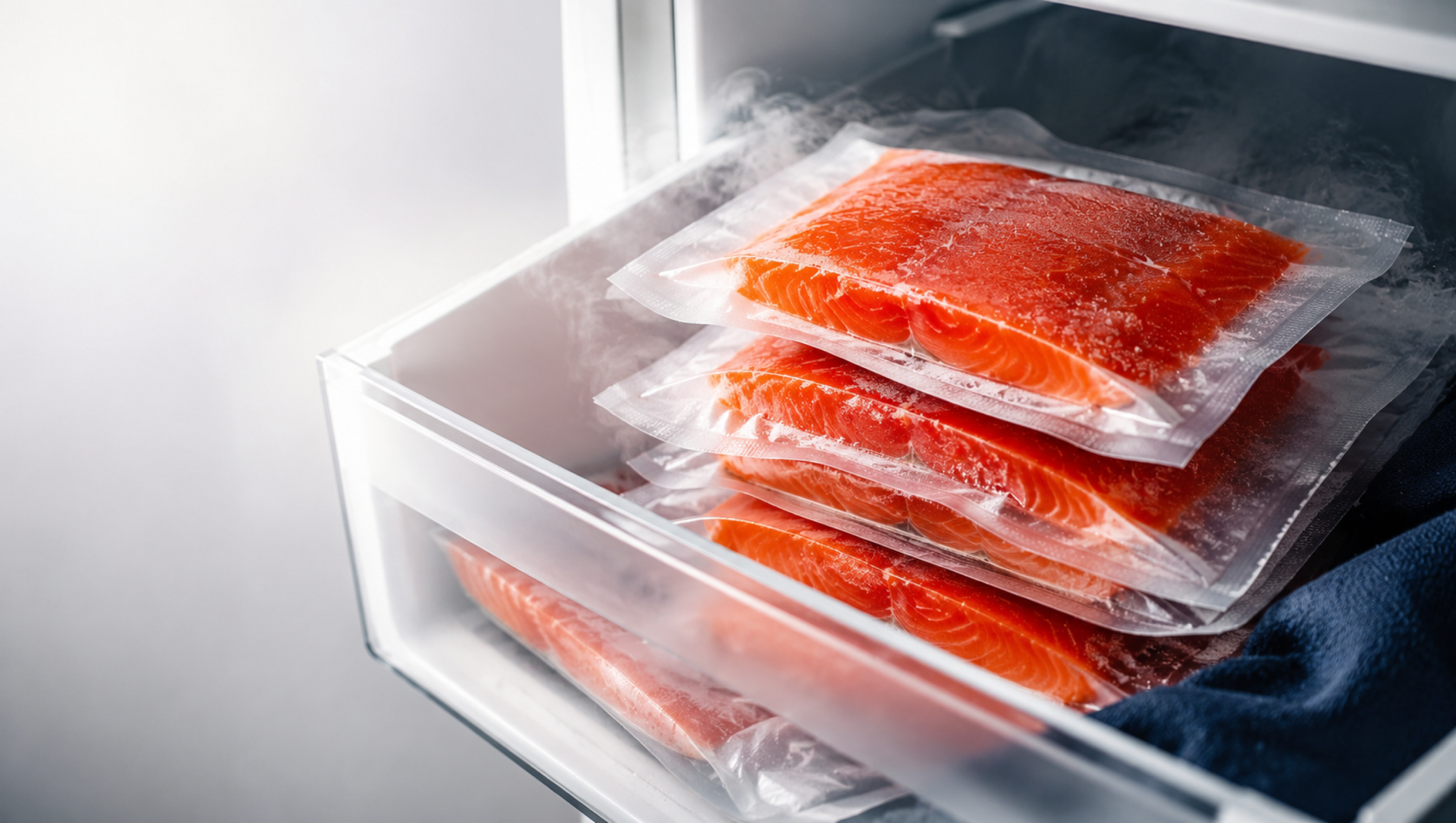
The freezer is where wild salmon shines. Properly frozen and vacuum-sealed, wild salmon can hold its peak quality for 6–9 months at 0°F or below. That is roughly 3x longer than salmon wrapped in plain plastic wrap or stored in a non-airtight container, where freezer burn and oxidation start to degrade quality after 2–3 months.
Why vacuum-sealing matters
Freezer burn is not bacterial spoilage. It is moisture loss from the surface of the fish as ice crystals sublimate directly from solid to gas in the dry freezer environment. Once the surface is dehydrated, oxygen also penetrates and starts oxidizing the fats. The result is the gray, papery patches and rancid taste people associate with old freezer fish.
Vacuum-sealing prevents both: no air contact, no moisture loss. This is how commercial fish is shipped and how our family handles every fillet that leaves our boat. It is also why flash-frozen, vacuum-sealed wild salmon can be functionally fresher in your freezer at month 8 than counter fish was on the day you bought it.
Flash-Frozen vs. Home-Frozen
Commercial flash-freezing (sometimes called IQF, for individually quick-frozen) brings salmon from 32°F to -30°F or colder in under 90 minutes. At those speeds, the ice crystals that form inside the fish are tiny — small enough that they do not rupture cell walls. Home freezers take 12–24 hours to fully freeze a fillet, forming much larger crystals that puncture cells. The result is a noticeable loss of texture and moisture on thaw. This is the single biggest reason flash-frozen DTC fish tastes better than store-bought salmon you freeze yourself.
How to home-freeze salmon as well as possible
If you bought fresh salmon at a counter and need to freeze it:
- Freeze immediately. Do not wait until day 2 of the fridge window — the fish degrades whether it is fresh or frozen.
- Portion before freezing. One meal-size piece per package. Thawing a whole side just to use 6 oz wastes the rest.
- Vacuum-seal if you have the equipment. If not, use heavy-duty freezer bags, press out as much air as possible, and double-bag.
- Set the freezer to 0°F or below. Many home freezers run at 10–15°F by default, which is not cold enough for long-term storage.
- Label with the date. Three months from now you will not remember when this went in.
- Use within 2–3 months for best quality.
5. Smoked Salmon: Shelf Life Rules
Smoked salmon plays by different rules from raw or cooked because the smoking process partially preserves the fish. There are two distinct kinds, and they last different amounts of time.
Cold-smoked salmon (lox, nova)
Cured with salt and smoked at temperatures below 90°F. The fish is technically still raw — the smoking provides flavor and partial preservation but does not cook the fillet. Cold-smoked salmon, sealed in commercial packaging, keeps 1–2 weeks unopened in the refrigerator and 3–5 days once opened. The salt and smoke slow bacterial growth but do not stop it.
Hot-smoked salmon
Brined and smoked at 145°F or higher, fully cooking the fish. Hot-smoked salmon (often labeled "kippered" or "smoked salmon for spreads") keeps 5–7 days in the refrigerator, similar to other cooked fish but with the extra preservation of the smoke.
For more on the smoking process and difference between the two, see our smoking & curing salmon guide.
6. How to Tell If Salmon Has Gone Bad
The storage tables are guidelines, not guarantees. Always trust your senses over the calendar. Here is how to tell, in order from most to least reliable.
Smell (the most reliable test)
Fresh salmon should smell clean, neutral, and faintly like the ocean — salty, mineral, almost like a clean tide pool. If it smells strongly fishy, sour, sweet, or ammonia-like, it has turned. Do not eat it.
The compound responsible for that strong fishy smell is trimethylamine (TMA), produced by bacteria breaking down the fish's natural compounds. The more TMA, the older the fish. Fresh fish has almost none.
Touch
Fresh salmon flesh should be firm and resilient. Pressing it lightly with a finger should produce a dent that quickly bounces back. If the dent stays, or if the flesh feels slimy, sticky, or mushy, the fish has begun to break down.
Sight
Fresh salmon has bright, vivid color — deep red for sockeye, orange-red for coho and king, lighter pink for pink salmon. The flesh should look slightly translucent at the edges. Spoiled salmon often shows dulling, grayish discoloration, or a yellowish tinge. Dark spots, white film, or any visible mold means throw it out immediately.
The packaging
A vacuum-sealed bag that has lost its tight seal and is now puffy is a warning sign — bacterial activity inside is producing gas. Discard.
When in doubt, throw it out
Salmon is a high-value food, but it is not so valuable that risking foodborne illness makes sense. Spoiled fish can cause scombroid poisoning, ciguatera-related issues, or general food-borne bacterial infection — all of which are deeply unpleasant. The cost of a fillet is much lower than the cost of a day lost to food poisoning. If anything seems off, do not eat it.
7. How to Make Salmon Last Longer
The single biggest factor in salmon shelf life is the temperature it has spent its time at since being harvested. The colder and the more consistent, the longer it lasts.
Five practical extensions
- Buy flash-frozen, vacuum-sealed wild salmon. The cold chain is preserved from sea to your freezer. You control the thaw point, which means the 1–2 day fridge clock starts in your kitchen, not in the back of a grocery delivery truck.
- Keep your fridge at 38°F or below. Most home refrigerators ship set at 40–42°F. Drop it to 36–38°F and salmon shelf life jumps measurably. Buy a $10 freezer thermometer to verify the actual temperature.
- Use ice on the bottom shelf for fresh fish. Salmon resting on a bed of ice in a covered container holds at 32°F — the boat standard. This roughly doubles the fresh window.
- Vacuum-seal before freezing. If you bought fresh salmon and want to freeze it, vacuum-sealing extends the practical freezer window by months. A basic home vacuum sealer pays for itself the first time you freeze a whole side of salmon.
- Freeze portioned, not whole. Freeze in single-meal pieces. Each thaw is one opportunity for bacterial growth — thaw only what you will eat.
8. Safe Thawing & Refreezing Rules
The best thawing method: refrigerator, overnight
Before refrigerator thawing, open or remove the vacuum packaging. Place the salmon in a shallow covered container in the bottom of the refrigerator, keep it refrigerated, and follow any package or processor instructions.
Once thawed, the salmon is good in the fridge for 1–2 days. You can refreeze it before cooking if necessary, but quality will suffer.
The fast thawing method: cold water
For when you forgot to plan ahead. Submerge the vacuum-sealed salmon in a bowl of cold water. Change the water every 30 minutes to keep it cold. A 6 oz portion thaws in 30–45 minutes, a 1 lb fillet in 60–90 minutes. Cook immediately after thawing.
Methods to avoid
- Counter thawing. Salmon left at room temperature enters the bacterial danger zone within 30 minutes. Never thaw on the counter.
- Hot water thawing. Same problem — the outer layer warms into the danger zone before the inside has thawed.
- Microwave thawing. Uneven heating partially cooks the fillet in places, damaging texture. Use only as a last resort and cook immediately.
Can you refreeze thawed salmon?
Yes, but with quality trade-offs. Thawed-then-refrozen-raw salmon loses noticeable texture and moisture on the second thaw — the second round of ice crystal formation does more cell damage. Thawed-then-cooked-then-frozen salmon is safer and holds better — the cooking step locks in proteins before the second freeze.
For a detailed comparison of all four thawing methods, see our how to thaw frozen salmon guide.
9. Frequently Asked Questions
How long can salmon stay in the fridge?
Raw salmon stays in the fridge for 1–2 days at 38°F or below. Cooked salmon stays for 3–4 days. Smoked salmon (cold-smoked) stays 1–2 weeks unopened and 3–5 days once opened. Always trust your nose over the calendar.
How long does salmon last in the freezer?
Flash-frozen, vacuum-sealed wild salmon lasts 6–9 months in the freezer at peak quality. Home-frozen salmon (not vacuum-sealed) lasts 2–3 months before freezer burn and oxidation noticeably degrade quality.
How long does cooked salmon last in the fridge?
3–4 days, refrigerated at 38°F or below within 2 hours of cooking. This applies whether the salmon was baked, grilled, pan-seared, or poached. Reheat once and eat — do not reheat multiple times.
Can you eat salmon that has been in the fridge for 5 days?
If raw, no — that is well past the 1–2 day safe window. If cooked, the 5-day mark is past the 3–4 day window. Even if the salmon still smells fine, bacterial counts may have reached unsafe levels. The 3–4 day cooked fridge limit is a USDA recommendation based on safety margins. Throw it out.
How long is salmon good in the fridge after thawing?
1–2 days from the moment the salmon is fully thawed. The thaw point resets the fresh-fish clock. If you thawed in the refrigerator overnight (the recommended method), you have 1–2 days from the next morning.
How can I tell if salmon has gone bad?
The most reliable test is smell. Fresh salmon smells clean and slightly oceanic. Spoiled salmon smells strongly fishy, sour, or ammonia-like. Touch is the next best test — fresh salmon is firm and bounces back when pressed. Slimy or mushy texture means it has turned. Dull color, gray patches, or any visible mold are conclusive: throw it out.
Why does my fresh salmon smell fishy already?
It is older than the label suggests. "Fresh" salmon at a grocery counter has often been thawed (from frozen-at-sea fish), set out on ice, and waiting for a buyer for 3–7 days. By the time you get it home, the bacterial breakdown has been underway for a while. This is the strongest practical case for buying flash-frozen direct-to-consumer fish: the cold chain stays intact until your freezer.
Is it OK to eat salmon past the sell-by date?
The sell-by date is the store's deadline for selling, not the consumer's deadline for eating. Salmon stored properly may be perfectly fine 1–2 days past the printed date, or it may be spoiled before the date. Always trust your senses (smell, touch, sight) over the printed label.
How long does canned salmon last?
Unopened canned salmon lasts 3–5 years in the pantry. Once opened and transferred to a sealed container, it lasts 3–4 days in the refrigerator, same as any cooked salmon.
Does vacuum-sealed salmon last longer than regular packaging?
Yes — significantly. Vacuum-sealing removes air contact, which prevents oxidation, slows fat rancidity, and eliminates the conditions that cause freezer burn. Vacuum-sealed wild salmon in the freezer holds peak quality for 6–9 months, compared to 2–3 months for salmon in standard plastic wrap.
Skip the Counter Math
Every fillet from our boat is flash-frozen and vacuum-sealed within hours of being caught. It arrives at your door still frozen, ready for 6–9 months in your freezer at peak quality. No guessing how long the counter fish has been thawed.
Shop Wild Alaskan Seafood →