
How to Remove Salmon Skin
By Tony Neal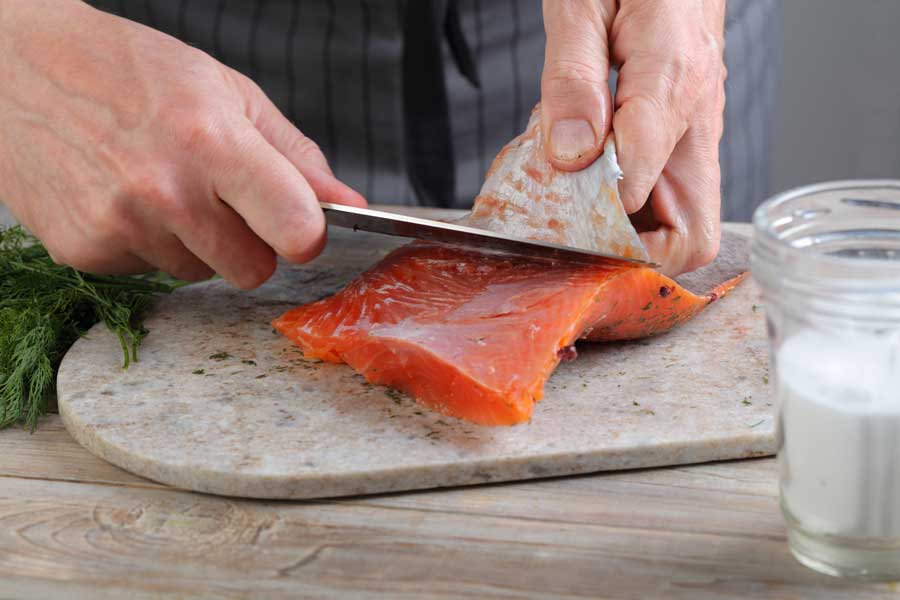
Removing the skin from a salmon fillet takes about thirty seconds once you know the angle to hold the knife. You do not always need to do it, wild sockeye skin crisps up beautifully and is full of omega-3s, but for steaming, poaching, or certain recipes a skinless fillet cooks more evenly. After 37 years filleting sockeye in Bristol Bay, here is exactly how we do it.
Should You Remove Salmon Skin?
Keep the skin on for grilling, roasting, broiling, and pan-searing; it shields the flesh from the heat and crisps into something delicious. Take it off when you are steaming or poaching, when a recipe calls for skinless portions, or simply when you prefer it that way. Either way, do not throw the skin out. Crisp it up and use it (more on that below).
What You'll Need
- A thawed wild salmon fillet, patted dry
- A long, sharp knife (a boning, fillet, utility, or chef's knife) with a blade longer than the fillet is wide
- A stable cutting board, ideally with a damp towel underneath to stop it sliding
How to Remove Salmon Skin, Step by Step
- Thaw and dry the fillet. Thaw overnight in the fridge and pat both sides dry so your grip does not slip.
- Position it skin-side down, tail toward you. The narrow tail end is your starting point, so you can cut away from yourself toward the wider end.
- Make a starter cut. About an inch from the tail, slice straight down to the skin, then turn the blade flat at roughly a 45-degree angle. Free a one-inch tab of skin.
- Grip the skin and slice. Hold that tab firmly. Keep the blade angled slightly down toward the skin and use small forward strokes with steady pressure, letting the skin pull taut against the knife as you go.
- Stay close to the skin. Hug the skin so the rich salmon fat stays with the fish, not on the scrap.
- Pat dry and cook. Wipe the skinless fillet dry and it is ready for the pan, the pot, or the steamer.
The Middle-Start Method for Portions
If you are cutting the fillet into portions anyway, start in the middle instead. Slice straight down to the skin in the center, angle the blade, and skin one half. You are then left with a large flap of skin to grip while you skin the other half. It is the easiest grip of all.
How to Get Skin Off Cooked Salmon
On a cooked fillet the skin lifts away on its own. Slide a spatula between the flesh and skin while the salmon is still warm and the fillet releases cleanly, leaving the crisped skin on the pan or plate to eat separately.
Save the Skin: Crisp It Up
Salmon skin is a genuine treat, packed with omega-3 fatty acids, protein, vitamin E, and collagen. Crisp it in a hot pan with a little butter, salt, and your favorite spices until shatter-crisp, then crumble it over salads, soups, rice, or potatoes. It is every bit as good for you as the fillet. For more, read our guide to salmon skin.
Watch: How to Remove Salmon Skin
Prepare your salmon with confidence. Bristol Bay locals Apay'uq Moore and Susie Brito show you how to remove salmon skin.
Frequently Asked Questions
What is the easiest way to remove skin from salmon?
Lay the fillet skin-side down with the tail toward you, free a one-inch tab of skin at the tail, then grip that tab and slice forward with the blade angled slightly down against the skin. Keeping the skin taut does most of the work.
How do you get the skin off salmon?
Use a long, sharp knife held nearly flat against the cutting board. Start at the narrow tail, separate a small piece of skin, hold it firmly, and run the blade between the flesh and skin with short, steady strokes.
Should you remove the skin before or after cooking?
Both work. Raw removal gives you skinless portions for steaming or poaching. After cooking, the skin lifts off effortlessly with a spatula, which is the simplest approach if you are grilling or pan-searing first.
Do you remove salmon skin before grilling or pan-searing?
No. Leave it on for grilling, roasting, and searing. Cook skin-side down first so the skin protects the flesh and crisps up, then remove it at the table if you prefer.
Can you eat salmon skin?
Yes, and you should. Wild salmon skin is rich in omega-3s, protein, vitamin E, and collagen. Crisp it in a hot pan and use it as a garnish.