
Cooking & Nutrition
Is Salmon Skin Good for You? A Fisherman's Honest Answer
We have pulled sockeye out of Bristol Bay since 1987. Here is the truth about salmon skin: what is in it, when to eat it, and when to leave it on the plate.
Key Takeaways
- Salmon skin is edible; cooked skin-on, it crisps and helps hold the fillet together in the pan.
- Skin-on, a serving of wild sockeye brings collagen from the skin along with the vitamin D, vitamin B12 and selenium in the fish.
- Salmon averages 0.022 ppm mercury in FDA testing, about 45 times below FDA's 1 ppm action level.
- Crispy skin is achieved with a hot, dry pan, a patted-dry fillet, and patience — not a fancy technique.
- Eat the skin from wild-caught fish. Reconsider the skin from intensively farmed fish.
1. Is Salmon Skin Actually Good For You?
Short answer: for wild-caught salmon, yes — the skin is edible and brings collagen along with the fish. Long answer: it depends on where the fish came from, how it was handled, and how you cook it.
For three generations our family has been pulling sockeye out of the cold waters of Bristol Bay, and the skin always goes with the fish. It is not waste. It is not a texture problem to be removed before serving. Cooked properly, it is the best bite on the plate.
2. What's in a Serving of Wild Sockeye
The figures below are USDA FoodData Central values for a 3 oz cooked serving of wild sockeye. The skin also brings collagen.
Per 3 oz cooked serving (USDA).
Salmon is one of the few real food sources.
Supports normal energy metabolism.
Plus type I collagen from the skin.
Skin adds calories, not carbohydrates.
With just 4.7 g of fat.
Is Salmon Skin Fattening?
No, not in any meaningful sense. The skin adds a modest number of calories to a 3-oz portion. Salmon's fat includes the long-chain omega-3 fatty acids EPA and DHA, the form your body uses directly without conversion.
For context: a single tablespoon of olive oil contains roughly 120 calories. The amount of fat you get from salmon skin on a 3-oz portion is a fraction of that, and it brings nutrients olive oil does not.
3. Why Wild Salmon Carry Fat
Salmon are anadromous — they hatch in fresh water, migrate to the open ocean, and return to fresh water to spawn. To survive that journey, they need stored energy in a form their bodies can mobilize quickly. That form is fat.
That fat is where the long-chain omega-3 fatty acids EPA (eicosapentaenoic acid) and DHA (docosahexaenoic acid) are stored. They are the same compounds your doctor talks about when they tell you to eat more fish — the compounds linked in dozens of studies to lower triglycerides, reduced inflammation, and protection against cardiovascular disease.
Whether you keep the skin is mostly a cooking choice: skin-on fillets hold together better in the pan and give you a crisp, flavorful bite.
The Bristol Bay Difference
A 3 oz cooked serving of wild sockeye has about 730 mg of EPA + DHA omega-3s (USDA), and the reason comes down to one thing: they swim. Sockeye returning to spawn at Bristol Bay travel up to 3,000 miles in the open Pacific before turning home. That endurance load demands a heavy fat reserve. The fish you buy from Popsie has been eating krill, herring, and other forage for years to build that reserve.
For a deeper look at the omega-3 story, see our complete guide to omega-3 fatty acids in wild seafood.
4. Is Salmon Skin Safe? Mercury, Microplastics & PCBs
This is the question that gets asked most often, and for wild Alaskan salmon the answer is reassuring: salmon is one of the lower-mercury fish FDA and EPA list as “Best Choices,” and a 2004 study found PCBs and related contaminants lower in wild salmon than in farmed salmon.
Mercury
Fresh and frozen salmon average 0.022 ppm of mercury in FDA testing (FDA 1990–2012 table) — about 45 times below FDA's 1 ppm action level. You can read the full breakdown in our mercury in seafood guide.
PCBs and Persistent Organic Pollutants
PCBs (polychlorinated biphenyls) are fat-soluble industrial chemicals that bind to fatty tissue. In theory, this is the case where skin matters — because skin contains fat. In practice, a 2004 study (below) found these contaminants lower in wild salmon than in farmed salmon.
A 2004 study published in Science analyzed more than 2 metric tons of farmed and wild salmon and found organochlorine contaminants, including PCBs, “significantly higher in farmed salmon than in wild,” with European-raised salmon highest. These are 2004 data, and salmon farm feeds have changed since.
Hites RA et al. Global Assessment of Organic Contaminants in Farmed Salmon. Science, 2004;303:226–229.
Microplastics
Microplastic contamination is a real concern in seafood, and the research on it, including how much reaches the parts of the fish people eat, is still early.
5. Wild vs. Farmed Salmon Skin
This is where the answer to "is the skin good for you" splits in two. The skin of a wild salmon and the skin of a farmed salmon are not the same food.
Wild Pacific Salmon Skin
From a fish that has spent its life eating krill, herring, and small forage species in cold open ocean. The skin is firm enough to crisp properly. Eat it.
Farmed Atlantic Salmon Skin
From a fish raised in a coastal pen, eating processed feed pellets often based on soy, corn, and rendered fish-oil. The fat profile shifts: more omega-6 for every omega-3. The skin is also typically softer and harder to crisp because of the lower muscle tone of a penned fish.
None of this means farmed salmon skin is dangerous. The FDA monitors it and it meets safety standards. But the nutritional argument for eating the skin — the omega-3 to omega-6 balance — is weaker. For a complete comparison, see our wild-caught vs. farm-raised salmon guide.
6. How to Cook Salmon Skin Crispy
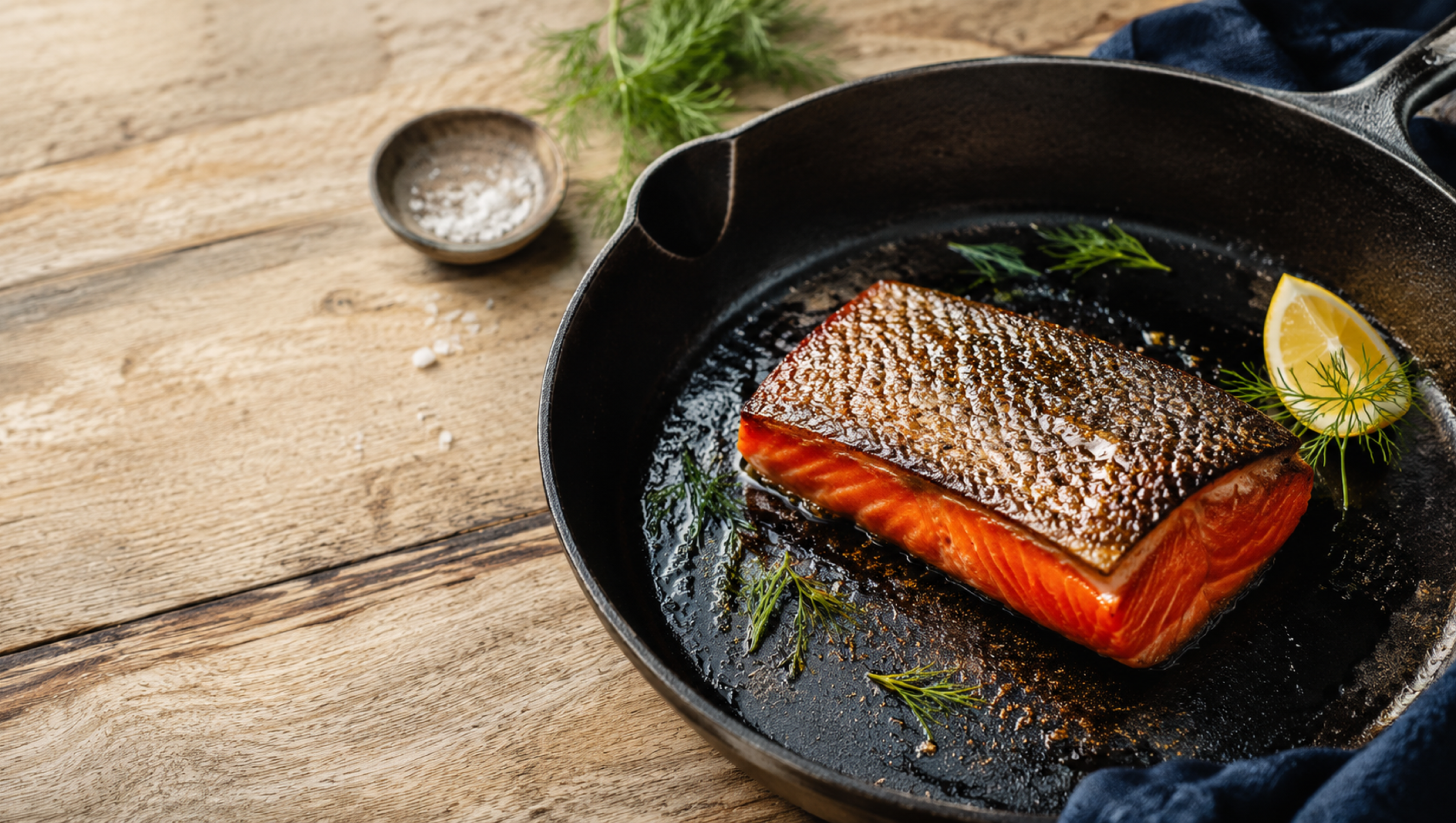
Crispy skin is the single best argument for eating the skin. Properly rendered, it is the texture and flavor people pay $40 for in a restaurant. It is also one of the easiest cooking techniques in the kitchen once you understand the principle. The principle is dryness and heat.
The 5-Step Crispy Skin Method
- Thaw the fish completely. Before refrigerator thawing, open or remove the vacuum packaging. Place the fish in a shallow covered container, keep it refrigerated, and follow package or processor instructions.
- Pat the skin bone-dry. Press a paper towel against the skin for a full 30 seconds. Then turn the fillet over and dry the flesh side too. Surface moisture is the enemy of crispy skin.
- Salt the skin generously, just before cooking. Salt pulls a little more moisture out and seasons the fat as it renders. Apply right before the pan goes hot, not earlier.
- Use a hot, dry, heavy pan. Cast iron or carbon steel are ideal. Heat the empty pan over medium-high for 2–3 minutes until a drop of water dances and evaporates immediately. Add 1 tablespoon of neutral oil with a high smoke point (avocado, canola, grapeseed).
- Lay the fillet skin-side down and do not move it. Press the fillet flat with a spatula for the first 30 seconds so the skin makes full contact. Then walk away. Cook 4–6 minutes without touching. The skin will release itself when it is ready. Flip, cook 1–2 minutes on the flesh side, and serve immediately.
The Single Biggest Mistake
Moving the fish too early. If you try to lift the fillet at 2 minutes, the skin will tear and stick. The skin releases itself when the proteins have fully set and the fat has rendered. Wait. If the spatula does not slide cleanly under the skin, it is not ready.
For a step-by-step video walkthrough, see our guide on how to get crispy skin on salmon.
7. When to Skip the Skin
The honest answer requires honest counsel. There are situations where the skin is not the right move.
- Poaching or low-temperature cooking. Skin does not crisp below 350°F. Poached salmon skin becomes rubbery and unpleasant. Remove it before cooking, or peel it off after.
- Recipes where texture would clash. Salmon en croute, salmon mousse, salmon for sushi/sashimi, gravlax. The skin is not part of the dish.
- If the fish was poorly handled. Skin from fish that was iced badly or held too long develops an off taste before the flesh does. If the skin smells strongly fishy or has a slimy texture, do not eat it. Do not eat the rest of the fillet either.
- If you simply do not enjoy it. The skin is optional. If the texture is not for you, eat the flesh and move on. You are still ahead.
8. Recipes That Use the Skin
The best recipes for skin-on salmon are the simplest ones. The goal is to let the skin crisp and the flavor come through.
- Pan-Seared Sockeye Salmon — the canonical skin-on preparation.
- Grilled Alaska Sockeye with Compound Butter — skin-down on the grates protects the fillet.
- Garlic Butter Sockeye Salmon — quick weeknight version.
- Blackened Sockeye Salmon — the bold preparation that lets crispy skin shine.
- Honey Garlic Sockeye Salmon — sweet glaze on top, crisp skin on the bottom.
9. Frequently Asked Questions
Is it OK to eat salmon skin every day?
If the salmon itself is OK to eat every day, the skin is too. The Dietary Guidelines for Americans recommend at least 8 ounces of seafood a week, and FDA and EPA list salmon among their lower-mercury “Best Choices.” The skin does not change that math.
Does salmon skin have parasites?
Wild fish can carry parasites, which is why the FDA advises freezing fish meant to be eaten raw at set temperatures and times to destroy them. Cooking also destroys parasites; the FDA's guidance is to cook fish to an internal temperature of 145°F. Our sockeye and halibut are flash-frozen to meet the FDA's parasite-destruction freezing guidance for fish eaten raw.
Can dogs eat salmon skin?
Cooked salmon skin from properly handled wild fish can be a treat for dogs in small amounts. Do not feed raw salmon or salmon skin to dogs — raw Pacific salmon can carry a fluke parasite (Nanophyetus salmincola) that causes salmon poisoning disease in dogs, which is fatal if untreated. Always cook salmon and skin before giving to a dog.
Is salmon skin keto-friendly?
Yes. Salmon skin has trace carbohydrates and a high fat content, making it an ideal protein for keto and other low-carb diets.
Why does my salmon skin always stick to the pan?
Three reasons in order of frequency: (1) the skin was not patted dry, (2) the pan was not hot enough when the fish went in, (3) you tried to flip it before the skin had released itself. Fix any one of those and the problem goes away. See section 6 for the full method.
Is salmon skin good for skin (your skin, the human kind)?
The collagen in salmon skin is type I, the same type that makes up the structural framework of human skin. There is some preliminary research suggesting dietary collagen from marine sources may support skin hydration and elasticity, but that research is early.
Does the skin contain the same omega-3s as fish oil supplements?
Yes — the same EPA and DHA. The advantage of eating salmon, skin and all, over taking a supplement is that you also get the protein, the collagen, the vitamin D and the other nutrients in real food.
Is grocery store salmon skin worth eating?
Depends entirely on where it came from. If the label says "wild Pacific salmon" or names a specific species (sockeye, king, coho, pink, chum) and origin (Alaska, Bristol Bay, Copper River), the skin is worth eating. If the label says "Atlantic salmon," it is almost certainly farmed — the skin is safe to eat but the nutritional and flavor argument is weaker.
Try Skin-On Wild Sockeye
Every sockeye fillet we ship comes skin-on by default. Caught in Bristol Bay by our family, flash-frozen soon after harvest, and delivered to your door. No subscription, no middleman.
Shop Wild Alaskan Salmon →